How can British Airways repair it's reputation
British Airways CEO Sean Doyle’s letter to customers signals a transformation for the airline and its reputation. But will it deliver and how can it regain confidence in aggressive short and long-haul markets? Simple, redesign the offer and engage Communications and digital innovation professionals to the job.

Earlier this week British Airways CEO Sean Doyle sent a letter to its customers outlining his commitment to restoring the airline’s focus on delivering a premium service to passengers.
In its over 600 word letter, Doyle recognised issues with its in-flight offering and customer service, issues that’s led the UK flag-carrier to be positioned as one of the worst airlines in short and long-haul travel according to a pre-pandemic poll by Which magazine in the UK. The influential Skytrax ranking also put BA in 19th place.
Complaints about BA are nothing new, with the airline finding it difficult to meet the expectations of customers. Let’s remember that this is a company that once describe itself and was perceived as “the world’s favourite airline.”

BA letter from CEO Sean Doyle
How BA fell from grace
But since that great advertising campaign, British Airways has found itself squeezed between rivals in the short-haul routes in Europe and new entrants from the Middle East and Gulf in the long-haul market.
The likes of Easyjet and Ryanair offered quick and low-cost services to passengers, undercutting BA, which even though it invested in the creation of Go in the late 1990s, it sold to a management buy-out, which they sold again to Easyjet - great strategy by EasyJet. In the long-haul environment, the likes of Emirates, Etihad and Qatar Airways invested in hub strategies, while BA’s business to Asia and beyond was point-to-point. The gulf carriers invested in a premium service at lower costs than they could offer, again, challenging BA.
While BA was a victim of changes in the market its strategic decisions damaged its offering and the wider reputation of the airline. It is this negative perception that BA has found hard to shift and which Doyle is now looking to resolve as the world moves from a pandemic to an endemic with regards to COVID-19. But the transformation is not going to be easy.
The public, as Cat Rutter Pooley points out in the Financial Times, expects the quality from yesteryear. BA, in essence, has ‘a nostalgia problem’.
Redesigning the offer from BA
In his letter to passengers, Doyle has signalled that he is committed to revitalising the airline, repairing its reputation and ensuring that it offers a premium service. He owns the situation that the airline finds itself in and makes a personal commitment to ‘build a better British Airways’, something that won’t be easy.
Of course, the letter he’s shared will have been drafted by the communications team. They would have checked all content and commitments that he makes. It would have been drafted to asks people for time and, as I read it, to inform them of the changes ahead
Using the word ‘transparency’ so early on is quite risky and this would have been a decision and strategy designed to make the airline more open and approachable. But for the perception of transparency and openness to be adopted by the public and passengers it really needs to be just that.
Equally, when asking for passengers to be patient, as Doyle asks, customers need to know what is happening and when. And what premium service means.
Doyle states that he knows that issues exist with call centres and he is committed to resolving these, a win if he’s able to deliver this at pace. He also states that “complimentary water and snacks” will continue on short-haul flights - something that to me doesn’t sound premium in any way.
What I read from the open letter is that Doyle and BA have embarked on a transformation programme that aims to reposition the airline as the world starts to fly again.
Before the pandemic, I used to fly quite a lot to Asia and throughout Europe for work. I hesitated using BA when the offer, price and experience from the Gulf carriers were much better. Equally, when in Asia, low-cost airlines like Air Asia, Silk Air or Scoot - owned by Singapore Airlines, offered a much better experience onboard, online and on their Apps. Simple things that made flying a pleasure.
These Asia carriers made a commitment to innovation. Their experience on their apps was great. BA’s is still lacking and needs to focus on innovation and ensuring that the digital environment through which passengers can book and manage their booking is premium.
How BA can regain its reputation for premium service

Qatar Airways App - Design for Passengers
Firstly, it needs to know what’s the perception its customers and the wider travelling public have of the airline and the service it currently delivers while knowing what it wants it to deliver. Bridging the gap between these two, and exceeding expectations is the work that will help it rebuild its reputation.
To achieve this it needs to measure itself against its competitors and see how it can reshape its offering.
Communications professionals within BA will need to embed themselves within the transformation team/s in order to see the iteration of the service across its various cabin classes. They will need to speak upwards to ensure that changes made meet and exceed expectations.
Stakeholder mapping will be essential and from a communications perspective, knowing your influencer market will be a critical area of work during the iteration of the offer and the revealing of it.
Personally, I would use Agile and design-thinking to ensure that British Airways is able to find where it fits in the market. Yes, low-cost carriers will undercut it on price, but where can BA win on service and experience?
At the same time as the transformation is taking place and improvements are made across the various touchpoints where passengers and customers form an opinion, a strong narrative will need to be created with messaging that confirms the premium of the service that BA are focused on delivering.
Comms needs to embed itself across the transformation programme to enable it and its internal teams to design and deliver a better service and experience.
I used to be a frequent traveller and I hope that I can return to BA once again!
The impact of social media on trust
Last week the Edelman Trust Barometer 2022 and the Royal Society’s research on the online information environment highlighted the impact of social media on the decrease in trust and reputation of governments and the media. How can this be resolved?
Last week two reports were published that reveal the impact of social media on the level of trust that people have of politicians, businesses and generally our daily lives.
The first report was the Edelman Trust Barometer 2022, which sadly found a continued decline internationally of trust that people have in their respective governments and the media, with nearly ‘1 out of 2 respondents viewing governments and the media as divisive forces in society.’
The second one was released by the Royal Society and which looked at the online information environment and how digital technologies are changing the way that people interact and consume news, information and other content.
A key issue that both of these reports highlighted is the rise of misinformation on social networks and the influence it is having on how our opinions are being shaped, making us more tribal and less open to debate or collaborate.
Misinformation and disinformation aren’t new concepts. They have existed for quite some time and have been used directly or indirectly to secure attention and some form of influence. The difference today is how it has gone mainstream thanks to social media and the algorithms that help amplify content that secures greater engagement, regardless of stories being unverified as facts.
The Edelman report highlighted that distrust is now ‘society’s default emotion,’ with nearly 6 in 10 people saying that their default tendency is to distrust something until they see evidence it is trustworthy.
Both the Edelman report and the recent Reuters Institute for the Study of Journalism 2022 Trends report highlight how more people than ever before get their news from social media and messaging apps like WhatsApp. What we see now is the impact that Web 2.0 has had on society since Facebook, Twitter, YouTube and others were formed 15 years ago.
Yes, social media has connected people and given everybody a platform and a voice through which we can engage, communicate and be better heard. But it has also enabled those with ulterior motives to influence and condition thinking.
By nature, people gravitate into groups that share their interests and opinions and by default build trust with people in these communities, creating influencers.
The dynamics of social media communities and how they grow and how and who influences people within them is an issue that I have studied and advised on for the past 10 years. A key rule to understand is the 1/9/90 Rule, where 1% are the creators, 9% are the contributors and 90% are the consumers. This rule is critical when also mapping out stakeholder communities. As I often say, understanding your audiences and their opinions and what’s conditioned them is central to strategic communications.
Interestingly, the Edelman report also found that the content that people trust more now is that shared by people they trust and have a connection with, like friends, family or colleagues. And of course, if a member of your immediate circle shares misinformation without knowing then that piece of news stands a greater chance of being accepted by the recipient. Why? Because of the trust that exists.
Today we also find ourselves being time poor, yet with access to all the information in the palm of our hand. Being time poor for many means that we have less time to question the news and data that is in front of us, making us more reliant on the trust that exists between the person that has shared that content and ourselves.
Another finding is the increase in trust between people and the business community, with 60% of employees surveyed wanting their CEO to speak out on controversial issues they care about and 80% of the general population wanting CEOs to be personally visible when discussing public policy with external stakeholders or work their company has done to benefit society. Yes, businesses are not yet addressing societal issues, but a move appears to have started.
In particular, CEOs are expected to shape conversation and policy on jobs and the economy (76%), wage inequity (73%), technology and automation (74%) and global warming and climate change (68%).
From a communications perspective, knowing what our publics want and expect helps us take these issues internally and have these conversations so that we can better advise business and policy makers on their respective strategies. Failure to listen and to have external views heard often leads to increased risk to reputation and decrease in trust.
So, how can we resolve these critical issues?
You would think that improved regulation would resolve that, but no. In it’s report, the Royal Society ‘stresses that censoring or removing inaccurate, misleading and false content, whether it’s shared unwittingly or deliberately, is not a silver bullet and may undermine the scientific process and public trust. Instead, there needs to be a focus on building resilience against harmful misinformation across the population and the promotion of a “healthy” online information environment.’
The Royal Society’s argument is that citizens would feel their worst suspicions confirmed, regardless of them being false, if “established institutions took a much more hands-on role in limiting people's access to information."
In public relations terms, think of it like using ‘spin,’ when the optics clearly show the public a negative situation. The public will see through this and further think negatively of the individual or organisation.
In this era of social media, where opinions are shared very quickly and influencers can dissect arguments in real-time, what is needed is not censorship or spin, but factual transparency.
To become trustworthy and develop and protect your reputation an organisation needs to be able to demonstrate and communicate it, hence the importance of being transparent.
It is becoming harder to develop and earn and maintain trust and a positive reputation. Yet what we need to understand is that trust and reputation is not owned by an individual or organisation, it is an asset bestowed on the organisation or leaders by their audiences and stakeholders.
Tactics and warm word alone won’t help convince people to trust an organisation, actions will!
Does no-one care about risk and reputation management?
Risk and reputation management are critical skills in the communications profession today. Why are they lacking?
For the past two or so months No.10 has been caught up in a negative media cycle after it emerged that parties, after work social gatherings and even a ‘bring your own booze’ events took place while the country was in lockdown. Late last night The Daily Telegraph also reported that two additional parties were also held in No 10 while ‘the Queen and country mourned the death of Prince Philip.’
One of the many things that the drip, drip, drip from these stories reveals is a total lack of understanding in the reputation and risk management skill-set amongst those who are in communications and advisory positions at the heart of this team.
Politics aside, what a Government needs are no distractions so that it can effectively push out, promote and secure engagement for its policies. A key component that helps secure engagement is trust. Trust that gives decision-makers confidence. Trust that helps shape positive reputations. Yet, this specific risk awareness and reputation management skill-set appears to be extremely lacking.
The Chartered Institute of Public Relations defines our work in communications as ‘the discipline which looks after reputation, with the aim of earning understanding and support and influencing opinion and behaviour.’
Of course, we know that some within the bubble raised awareness of their concerns for how these events might look if they were leaked. Yet events still took place and leaks about them taking place shaped the media narrative which damaged the reputation of the Government.
When Allegra Stratton resigned after the video of her and her team’s press conference rehearsal in which the mock question was asked about the party that took place, well that highlights the issue and the reliance on spin and deception. Today, these tactics just do not work.
Public relations today is about identifying risk and stopping such situations from ever happening. Sadly though, in too many organisations PR is still seen for it’s media engagement, for trying to cover and bat away issues and decisions that have already taken place, even though we live in a hyper connected world where the truth eventually comes out.
When I worked in Government, midway during a presentation that a team that I was part of was giving to a very Senior Civil Servant, questions were asked about risk - risk to delivery dates and risk to reputation of Ministers. They were focused on protecting their reputation and to ensure that we worked to that standard. It was a light-bulb moment.
I also been in other situations where I spotted issues by members of the then press team, which I raised with them and then help them unpick to ensure that they are us were protected. Why? Because I thought three to ten steps ahead and wanted to be sure that my team’s reputation and that pf the project that we were working on were protected..
Equally, when training communications teams here in the UK and overseas, I have always told people to ‘people-watch’, to step outside the bubble and learn about them and how they form their opinions, how they use social media and are conditioned.
In communications today, reputation awareness and management is more important than ever.
A golden rule to remember is that ‘perception of the crime can be more damaging to reputation than the crime itself.’ When it comes to these parties, both the crime and the perception of these will have serious consequences.
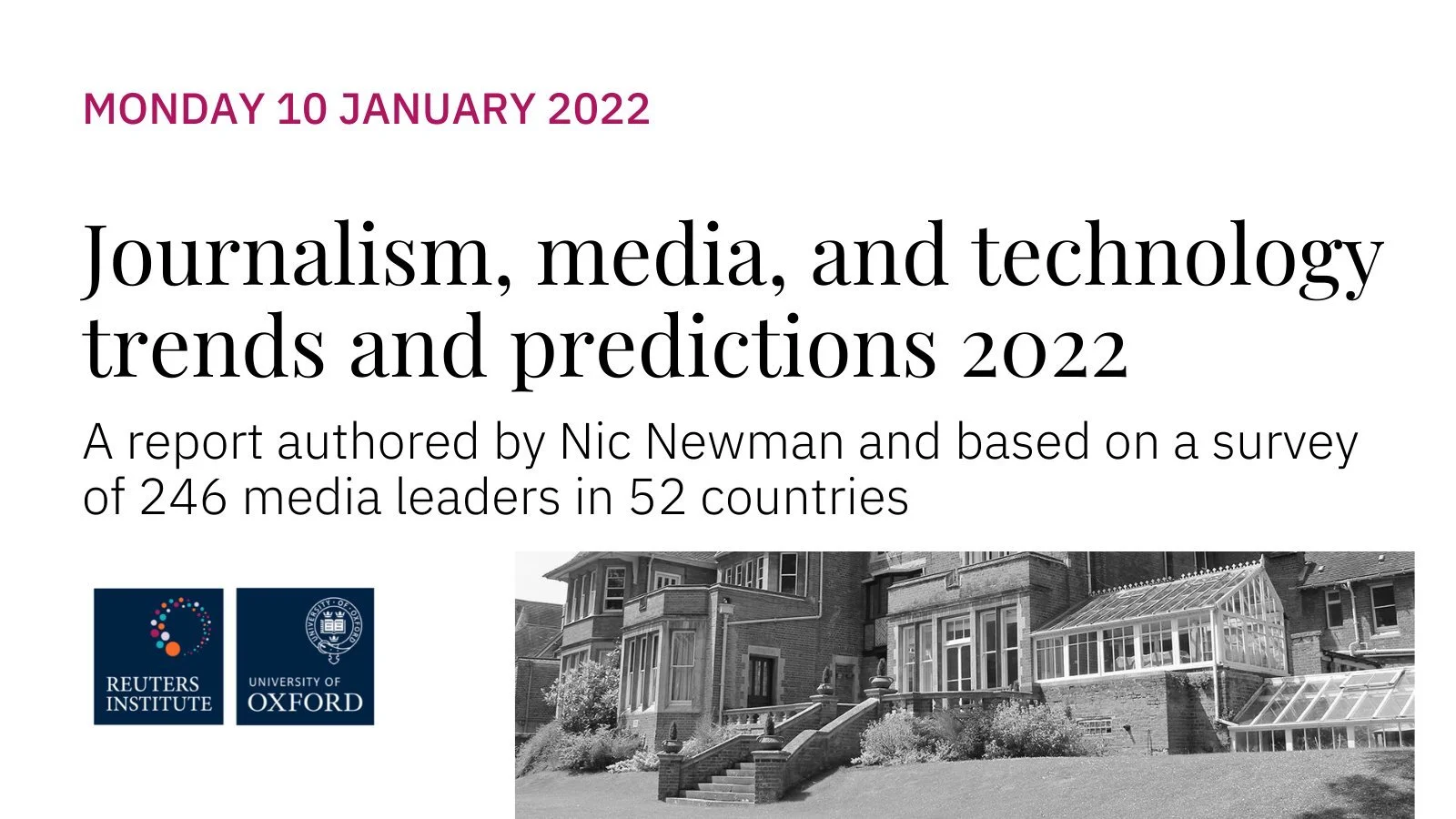
My view of RISJ's Journalism, Media, and Technology Trends and Predictions 2022
Mt view of Reuters Institute’s Journalism, media, and technology trends and predictions 2022

Journalism and the news and media world has been challenged and disrupted. What we have seen from the past year is the slow drip-drip-drip of both how people have shifted their news consumption to social and digital platforms and the rise of ‘influencers’ that have learnt how to game algorithms of these platforms to retain and monetise their communities. Media outlets have either ignored the signs or just been too slow to pivot their content and storytelling to meet the changes in how people consume news and wider content.
Today’s sees the release of the Reuters Institute for the Study of Journalism’s ‘ Journalism, Media, and Technology Trends and Predictions for 2022’ report.
Written by Nic Newman, this years report interviewed 246 executives from 52 countries from around the world.
So, what can we take from this year’s report? Well, that once again we find the news and media industry at a crossroads, I’d say at the edge of a precipice even. For the last number of years, the essential disciplines of journalism and fact-checking have been losing the battle to keep audiences informed of facts. People have been and are continuing to pivot to online, social and messaging platforms and apps for their news.
The content and ‘creator economy’ has hooked many people into their communities and the messaging that they promote. Why? Simple really, they are just better at developing short-form content for time-poor people.
One of the key outtakes from this year’s report is about how non-media platforms and communities that have been pulling people away from traditional outlets have been better and more nimble at meeting the needs of audiences. For a variety of reason’s traditional outlets have been slow. Maybe they have just been in a bubble, needing to appeal to other influencers in their industry rather than the audiences that they are there to service and even, shock-horror, monetise from.
If you work in communications and public relations, there are some key aspects that you need to know about. I’m going to list ten that stand out for me.
Don’t just know your audience and the platforms that they use. Get to understand how they use these platforms and how and who shapes their views. User research is going to be critical in how you not such get your message across, but how you get buy-in.
Ignore media and journalism at your peril. The narrative for a good number of years is that you can bypass traditional media. You can’t. If you want to influence policy then remember who influencers policy-makers.
Plan your campaign with quality content and story-telling. But remember that to influence you need high-quality short-form content. With so much content around, audiences lose attention quickly and move on to something else. So plan your campaign with a story with content packages that you can drip out to keep audiences you want to influence engaged.
Content format is going to be key. But the problem that many will have is that to make it work they need their communications teams to be less rigid. Audiences flock to influencers because of their ability to tell a story, to make content relevant and engaging.
Over-marketed ‘all is good’ content will fail. Why? Because audiences out there of fact-checkers will quickly unpick all your nice glossy words and images. So be honest and transparent. Get your facts right and don’t over-sell.
Think of your content and your story-telling not just from your brand, but the stakeholders that help you deliver your products and/or services. Create a community, not just for your audience, but for the smaller SMEs that enable you to deliver your products or services. As an example, Arsenal Football Club has been running a great campaign promoting local businesses impacted by the pandemic.
Consider all formats and platforms that you have at your disposal and plan regular content for them. But design it from how and when your audiences consume content - audio with podcasts, videos with vodcasts and tweets and long-form for announcements. And think which platforms are best to be on. Maybe it’s all, maybe it’s some, but which. Design and deliver against your available budget.
Innovation is key - should you consider AR, web3, the metaverse and NFTs to name some key areas that are getting a lot of hype? Potentially yes, but don’t go in unless you do so professionally. Assess your position and the level of investment that you can make to present yourself, your organisation and your leaders in a professional way. In these early stages, you run the risk of damaging your reputation if you go in half-heartedly and if your audiences are just not in the space, yet. Look at your content and the visual assets that you own, your could monetise these through NFTs (if you own the rights!).
Think of the data that you have at your disposal and consider AI and machine learning (ML) to better craft and create content, and again, not just in a marketing quick-sale way.
Be objective and understand your audiences. The hardest job for a communications professional is speaking truth to power when they know what their audiences think and say. That experience and insight could save countless negative battles.
The media landscape is changing. Like it or not it has to change, but journalism and fact-checking are giving hope that misinformation and alternative facts are not a way forward. Just imagine how and what people will feel when they realise that everything they’ve been promised is, well, fake!
The Downing Street Communications Problem

Downing Street Press Conference
The UK Government has a serious problem. Its communications and public relations operations out of Downing Street are failing to control how the Government and its policies are perceived by the wider public.
The stories surrounding the Downing Street parties in November and December 2020 have lit a light of distrust in the government and the authority that they have, or lack.
Yes, you could question them and their policies on other matters, but this has hit a nerve and secured cut-through, not just with the public, but also the party. The issue now, is when blood and a body is wanted how does one deliver that? And how did we get here?
The Downing Street communications and political machine appear to be working in a silo, with a mentality of if you are not with us, then you’re against us. Never acknowledge, never apologise, a strategy that has run its course.
Culturally there is an issue where there appears to be a lack of experience for identifying and mitigating risk. Instead, the approach that has been taken on many issues is one of ‘carry one, ‘deny and spin,’ and present an ‘alternative truth.’ This over a sustained period of time has created an environment of mistrust, which creates an issue when you are looking to run a campaign where you need to take the population with you.
Even the UK’s Government Communication Service framework highlights the importance of focusing on outcomes, whether it is behavioural change, increase in awareness or recruitment when engaging in public-facing campaigns. But when trust is damaged by previous decisions, it is harder to take the audience with you.
For a policy or an awareness-raising campaign to succeed the messaging has to be relatable and relevant. People and other stakeholders need to trust the messenger if buy-in is to be secured. Trust is a critical component that is in short supply with the current because of the constant negative stories that keep emerging. And the stories are only negative because of the decisions that are allowed to be made. And so the question still is, why are they allowed to be made? Where are the advisors and do they question decisions before they are made?
Within central government, you have a great team of professional communicators, all of whom abide by the standards set by GCS. Then you have political appointees - SpAds. Again, from a comms perspective and politics aside both are responsible for safeguarding reputations. I have in the past questioned and challenged decisions being made, which has protected the reputations of those that I have worked for, even members of the comms team that I have worked with. But sadly, I have wondered about a culture where one does, as one is told, regardless of what the risk that you know exists.
In today’s world, rules matter and whatever you choose to do, using spin, diversion or a ‘dead cat strategy’, well, they no longer work because these strategies have become mainstream and understood. The public has lost trust and that makes it harder to be heard.
This does not mean the end of communications and public relations. If anything, listening and understanding the audience is what could help revitalise this profession. But for that to happen decision-makers are going to need to relearn that transparency and accountability are centre-stage.
Something needs to change, but culture is the biggest issue to change to enable trust to return.
Is it time for regulation of digital and social media companies?
On Friday evening, Twitter, Facebook, Google and other digital and social media companies began to purge the accounts of Donald Trump and his various followers.
It took an insurrection by pro-Trump supporters at the Capitol in Washington DC last week for the Silicon Valley titans to finally close his accounts and that of enablers who promoted his and other conspiracy theories.
Of course, Trump still has a large base with many advocates online promoting his views. They are there, exchanging violent content on various online forums like Parler.
But that it’s taken over four years, during which Trump has built a base based on lies and misinformation, is just incredible. With President-Elect Biden and the Democrats now controlling the White House, Senate and House of Representatives, there is now a wind of change that will affect how these tech companies operate. Increase regulation is on the agenda and not just in the US, but also in the EU, UK, Asia and other jurisdictions around the world.
Facebook, Twitter and YouTube have directly or indirectly benefited from having him and his crowd on their platforms. The more misinformation that was spread and consumed, the more engagement that took place on social media. This, as you’d expect, resulted in increased advertising-led revenue numbers. After all, advertisers want metrics that show these platforms get regular eye-balls and think about this, more than 98% of Facebook’s revenue in 2019 came from advertising. That’s how dependent these tech firms are on advertising income and engagement.
The speed at which social media companies have pivoted has been incredible. Every action now has been about protecting their position, reputation and revenue model. Sadly, a case of too little, too late.
Not surprisingly though, some are questioning about the legality of what digital social media companies are doing in limiting Trump in communication via Twitter, Facebook and YouTube. The ‘free-speech’ argument, which is flawed and a distraction. Let me go through this and other issues.
Aren’t the tech companies breaking US citizen’s first amendment’s rights to free speech?
No, the actions by Facebook, Twitter and Google does not break US citizen’s rights to free speech.
The first amendment (1A) of the US Constitution is there to protect citizens against government limits on their freedom of expression, but it doesn’t prevent a private employer or company from setting its own rules.
Just to be clear, the first amendment protects individuals against discrimination BY the government (or their agents, I suspect!).
These social media companies are private companies. They are entitled to set their own terms and conditions. If you’re on their platform, you abide by their rules. If you don’t like their rules then you can go elsewhere, like Parler, which many have.
How is the reputation of Facebook, Twitter, Google affected?
This is a huge issue. For many years, these Silicon Valley companies have been in front of lawmakers arguing their case and position. Safeguarding their business model.
Yet for years, eyes have been on them and the content they allowed on their platform.
When you looked at their revenues against the conversations that took place on Facebook, Twitter YouTube and others there was a clear issue. They profiteered from this and this damaged their reputation in the eyes of a certain core of lawmakers, as well as businesses and members of the public.
Since 1996, in the US they have had the protection of Section 230 of the Communications Decency Act of 1996, which has been described as “the most important law protecting internet speech” and called “perhaps the most influential law to protect the kind of innovation that has allowed the Internet to thrive.”
Purging accounts of individuals who have incited violence might be happening now, but it really is just a reaction to the new direction of the wind blowing.
Can Facebook, Twitter and Google benefit from this purge?
In my opinion, yes.
The current purge is taking place in 3 environments: 1) accounts and content on platforms such as Facebook, Twitter, YouTube; 2) Applications that host-hate based content on Apple and Google’s App Stores; 3) hosting companies, such as Amazon’s AWS, which up to yesterday hosted the free-speech App Parler.
A fringe will claim that Big Tech now controls free-speech. This is a complex argument, as you have to consider what is free-speech and the repercussion of what you say without consequences.
Tech companies are in the business of designing and building services that make money for them, their customers and shareholders.
During the last 4 years, if not longer, hate-based content, misinformation and conspiracy theories have brought unwanted negative attention to these companies tech companies. During this time some companies have been lobbied to not spend their big advertising money on these platforms. This hasn’t had a direct effect on Facebook and the like, as their revenue is generated more from small and medium based companies, than the enterprise corporations. That said, these larger organisations have greater lobbying power.
At the same time, conversations about the return on engagement of digital marketing has been influencing how small and medium-size businesses spend their limited budgets.
All this leads to a position where tech companies are having to seriously consider their reputation and, in my opinion, their advertising-reliant business model.
What next for the tech titans?
I wrote in an earlier blog post that regulation is coming and rather than digging their heads in the sand, tech companies need to look at themselves and move away from a libertarian insular view. Unlikely to happen of course and that is an issue for them.
Regulation doesn’t have to damage their business. What they have to do is look at their revenue model and consider what they have to do in order to better position themselves. They have regulators in the US, EU and UK to engage with.

12 Trends for 2021
Here are some technology, innovation, trade and public relations trends to look out for in 2021. Normally will be returning, but slowly and the appetite for innovation will be greater than ever.
2020 has been an eventful and unprecedented year. The COVID-19 global pandemic has disrupted everything. Yet, while the virus has challenged us, we have adapted, at pace. We’ve shown how nimble and resilient we can be.
The digital transformations that our businesses and governments have been going through, well, the pandemic turbo-charged them!
Lockdowns and circuit-breakers have all added petrol to the transformation of the way we live, work and play. Businesses have pivoted even more to online channels, creating increased competition and as a results customer expectations have been more difficult to meet.
The watch-words for 2020 have been survival, transformation and resilience. At the same time, reputations have been questioned even more. Trust has become the ultimate commodity in the public and private sectors alike.
So as we get ready for the year ahead, what are we going to face this year? What are the challenges? Well, here are my thoughts - 12 for ‘21:
Technology
After the challenging past year and with vaccines now coming on to market, we will see new technology receive major investments from the VC and CVC communities.
Getting vaccines to market at such pace and with such scrutiny has given businesses and start-ups in the life sciences and biotech sectors a huge boost.
Also, look out for automation, cloud and Software as a Service (SaaS) companies whose services will become attractive as a result of the increase in remote working environments that we have shifted to.
AR, an old piece of tech might be coming back to market. It is already there in the business community, but many rumours on what Apple is working on after Google tried Google Glass. Remember that?
I am not spending much time mentioning 5G, because it is just more hot air. It will make a difference to some technologies, but will it be transformational? And what about the extra experience that it will be giving to products and services and their respective consumer bases?
When you think about tech, don’t just think of tech and innovation being developed in their traditional geographical hubs, like the US or Europe. China is there, as is South East Asia with Singapore as a hub and a nation that is putting tech at the centre of how it wishes to be perceived. Asia has risen and is challenging!
Social Media
Regulation is coming to social media. We are moving from idle chatter on the fringes to clear political discussions in both the US and Europe. The appetite is there.
The damage that Facebook has created to the reputation of digital companies has focused minds, not just against them, but on Google and others.
Facebook knows this as it has embarked on a hiring spree in order to ready themselves for arguments in the UK, EU and US. Whether this investment comes to anything we will only know based on conversations that come to light, but the train has left.
In the US, Facebook is also facing antitrust suits at a federal and state level. The focus appears to secure the spin-off Instagram and WhatsApp from the firm.
In the US, these cases have bipartisan support, which is an issue of concern. Equally, there is a growing move to consider a GDPR law over in the US.
Privacy
Here in the UK, we know of privacy through having to comply with the European GDPR directive.
Again, on both sides of the Atlantic, privacy is an issue, with firms like Apple making it into a point of consideration when it comes to their offerings against those of Google, Facebook and others.
Let’s not forget that Facebook makes over 90 per cent of its revenue from advertising. It needs as much data as possible in order to offer better advertising services, compared to that of Google and Alphabet.
Both Facebook and Google rely on small and medium-sized companies for the bulk of their revenue.
Privacy is going to affect their business model as firms like Apple push hard in support of privacy on their devices. Apple makes its money from product sales, revenue and increasingly from streaming services. Compare this against the dependence on advertising by Facebook and Google.
The public spat between Facebook and Apple is down to protecting it’s revenue sources.
Self-regulation, or the lack of it, is an issue that will influence how privacy establishes itself amongst consumers as a must-have.
Innovation
The current pandemic will have an unexpected outcome with many more organisations looking at innovation to establish themselves and gain competitive advantage.
A key area is that of understanding behaviours of people and using this data to improve products and services. This data and the insight that it gives designers will bring in challenges around privacy. At the same time, new products will have a focus on influencing behaviours, something that will have ethical questions around it.
Artificial Intelligence (AI) and Machine Learning (ML) will also feature heavily this year. That said, away from the buzz and hype there will be growing expectations to see outcomes that confirm the investment in these areas.
AI and data analytics will be a focus in order to develop improved customer experience and service. Reputations will be built on the quality of customer experience and service.
Customer experience
Customer experience - the elephant in the room!
Little time is spent on this subject, but if 2020 saw a huge move to digital for many businesses, the ones that succeed in 2021 will be the ones whose products and services that have been designed around the behaviours of prospects and customers.
As the World Economic Forum points out, it is a time to ‘go digital or go bust.’
Being online is no longer the key to survival, especially with so many established brands competing for eyeballs and engagement. What will matter is the quality of the experience and the service.
Reputation and trust will be earnt and lost on how services are designed around the customers and users.
Personalisation and an integrated omnichannel approach will help businesses and public sector organisations better engage with their respective audiences.
And I’m not even talking about chatbots or the like, because unless these are designed and built well, they are a risk in my opinion.
Content
We will continue to see the continued battle to get content up and ranking on Google. High-quality SEO will continue to be there, but at the same time, there will be a move to community-based marketing, especially on closed groups on WhatsApp, Signal, Telegram and Facebook.
These groups are there to support others, promote new products or link up with people who share similar opinions and interests. We should note the impact of these groups, especially on Facebook to the spread of misinformation. While not all groups are influential, they do have influence on opinions.
In 2021 we will continue to see the rise of video. Just look at the success of TikTok and Instagram to see how people consume content. Dynamic web content will also gain further traction.
Immersive story-telling will improve the quality of content and make it more audience relevant.
At the same time, podcasts will continue to grow, but as they do, the biggest challenge is meeting a level of quality of expectation. Brands will have to be careful to not be so sales focused.
Cybersecurity
The COVID-19 pandemic has forced many companies to move their employees towards remote working structures. This increases risk, especially from phishing and social engineering attacks.
At the same time with more companies establishing cloud strategies, the security of these will be central to reputation management of public and private sector organisations.
Ransomware threats will continue to increase. It is not just about encrypting data and content, but stealing and profiting from it.
Trade
The elephant in the room. While the UK has left the European Union and ventures to establish further trade deals with economies around the world, others, like those in Asia has formed the ‘world’s largest trading bloc’
Fifteen Asian countries have signed up to the Regional Comprehensive Economic Partnership (RCEP).
While China is the main superpower, it also includes leading economies, like Japan, Malaysia, Indonesia, Vietnam and Singapore.
Equally, with a new administration taking office in the US, trade and investment will be on the agenda for Biden in the White House. Though, it’s immediate priority will be with the EU.
Rise of Asia
What holds us back in the West is our history. What leads Asia in the East is its culture.
Make no mistake, Asia has risen. It is here and is a huge trading bloc that through it’s Regional Comprehensive Economic Partnership (RCEP) will gain speed in how it works, trades and prospers.
The Fifteen Asia Pacific members that signed the agreement ‘represent 30% of the global economy, 30% of the global population and reach 2.2 billion consumers.’
While China sits at the centre, countries like Malaysia, Indonesia and Singapore will promote the opportunities they present to attract businesses to establish themselves in their respective markets.
The strength of rules based structures will support inward investment. Businesses need trust and legal certainty.
Public relations and communications
Public relations will continue to battle to be recognised on the board of organisations, compared to how it is close to power in government and the political world. The fact is that reputation matters and slowly, but surely the c-suite is recognising that it needs senior advisors and experts that can look beyond media headlines.
Management consultancies will start to eat into the public relations space. Their expertise on other management areas will see them better positioned to further develop this offering and sell it as a must have.
As the world starts to open again following the rolling out of the COVID-19 vaccine, there will be a need to more international and strategic expertise.
There will also be a need for understanding audiences and users. Customer experience and customer service will be key disciplines that become part of a communications capability.
Reputation will also become a key aspect for venture capital (VC) and corporate venture capital (CVC) when considering who to fund.
Influencers will continue to be a must-go this year like the media were 10/15 years ago. But make no mistake, thinking about short-term likes will create risk for brands.
Public relations and communications will continue to be the skill-set that focuses on developing and managing trust and reputation.
The battle against misinformation
Misinformation and disinformation campaigns will continue to be major issues in the coming year.
While the past year the focus of misinformation was on political issues, the coming year we will see challenges continue to be made against science and, specifically, vaccines.
Opinions and anecdotes will be used to spread falsehoods and conspiracy theories. These will continue to go through private groups on Facebook and WhatsApp, leaving online and social media companies at a loss as to how to fact-check what looks like first-hand experiences.
The lack of trust by parts of society in governments and people in authority will continue to hamper the battle against misinformation. Whack-a-mole campaigns will not achieve much unless there is a clear strategy and understanding of the issue. This is where we will see public authorities look at regulation.
Working from Home (WFH)
Let’s be honest. There’s been a lot of spin that working from home is the new normal and that offices in it’s pre-COVID set-up will not return. I don’t buy this.
The business and public sector community will return to the concept of the office. Maybe not as we saw it, but it will return. Office space will be crucial.
What will change is the acceptance that working from home is inefficient. The pandemic has proved that it is not. People have had to adapt to working remotely like digital nomads have done so for many years.
Working from home has turned our homes, our safe spaces, into places where we cannot relax. Because of this we will see locally based flexible office space where people can work remotely, without having to commute or do so from home. This in turn will enable a more collaboration and community focus around the suburbs that many people live in.
Happy new year!!
The communications challenge of getting people to take the COVID-19 vaccine
UK medical regulators today approved the use of the first coronavirus vaccine, a world-first that will be rolled out here in the UK in the coming days.
Science has delivered. Other vaccines, including the ones from Oxford/AstraZeneca and Moderna nearing regulatory worldwide.
The work and effort from scientists is what will bring back the sense of normality that we all crave to our daily lives and work. We have to congratulate them on their incredible work.
But there is still a challenge ahead before normal life returns.
Creating the vaccine is one thing, getting people to take it is another matter in these days where science is questioned by people who believe are influenced by misinformation and disinformation.
This is where an effective communications and engagement strategy needs to be designed and implemented.
At the press conference by the Medicines and Healthcare products Regulatory Agency (MHRA) and Joint Committee on Vaccination and Immunisation (JVCI) the tone was distant and not engaging. As Sky News Correspondent noted, it was, “So dull. Wonderfully, gorgeously dull.” And maybe there is a need for it. To give people confidence science needs to be transparent, open and accountable. Yet, the face of those selling and vouching these solutions need to better engage. They need to give confidence and reassure the public. The risk of failure is a risk to our daily lives.
People need to be able to relate to those they see. Messages need to be simple. Tone of voice has to be right. Experts need to be media trained to ensure that their expertise is engaging by people they are communicating with and there are many techniques to help achieve this. In past projects, I have brought in coaches from RADA to coach people to better present themselves and be more engaging.
Messaging to get people to trust the vaccine needs to be designed around the eternal communication principle of ‘focusing not on what we want to tell them, but what we want people to understand.’ There is a need to reduce the perception of risk that misinformation promotes.
Misinformation is always about influence and control, either by individuals or state actors and social media channels have allowed this to spread. Everyone has an audience, even those without experience. We have to be careful, but we must also spend time understanding the people that are concerned by the vaccines and create messaging and engagement activities that reassure.
This communications effort must work alongside our immunisation programme to ensure that we can open up the world again, to give people their lives back.
Let’s get ready for the effort ahead. I can’t wait to get the jab and it’s not just for me, but for those that are vulnerable.
The UK’s COVID-19 track and trace App is out
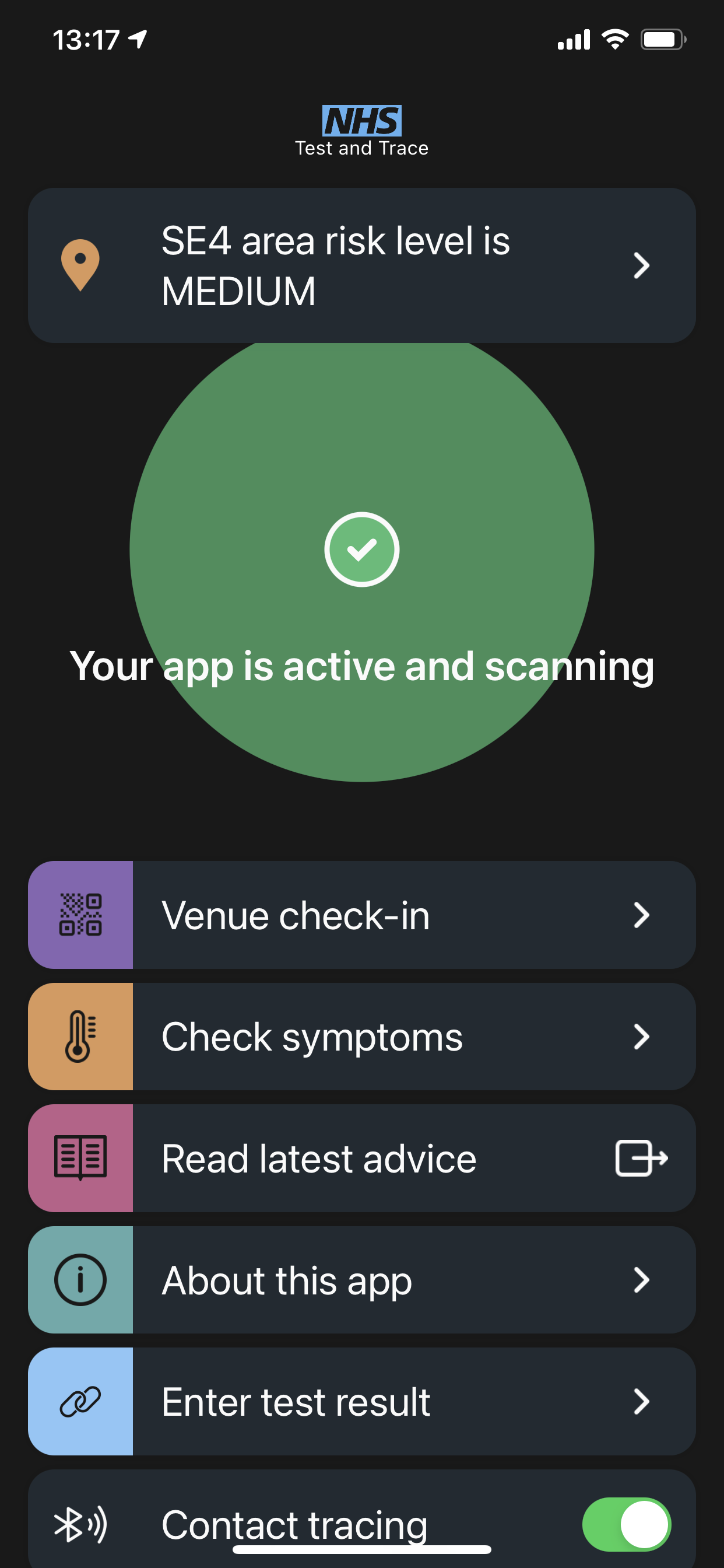
The UK’s COVID-19 track and trace app is out. Download it and use it, but for it to work all other parts of the service need to work.
The Department for Health and Social Care’s NHS COVID-19 app was released today after much delay.
In May this year, I wrote about the challenges that the development team would face in building and delivering their track and trace app, which at the time the Government described as being central in its battle to control the spread of this virus.
Countries around the world moved quickly to develop their own track and trace apps, many adopting the ‘decentralised’ model favoured by Apple and Google. This model made sense given the market share of Android and iOS operating systems in smartphones around the world. Yet, the UK opted on a different approach, before a u-turn back to the Apple and Google infrastructure.
While there still might be concerns and questions about the App, the issues are now not with the App itself, but with the associated support services, such as getting a COVID-19 test or the requirement to self-isolate if the App tells you if you have been close to has tested positive.
The challenge that Governments around the world face when developing and delivering public services is that users are hostage to the quality of these when they are delivered via digital channels. Good customer experience and trust is a must from the off.
In the commercial world, if a consumer wants to buy or sell something it has a choice of apps and companies, like eBay, Gumtree or Facebook Marketplace. If they don’t like the terms or the customer experience of one, then they can move to another provider. Simple, one business’ loss is another’s gain, but in the public sector when a service is poor the damage is to Government and their political reputation, which is why risk and reputation management is so critical in the development of digital services.
So where are we now with the new UK COVID-19 Track and Trace App? Well, it is here and the team have done a lot of listening to make sure it works, but there are still challenges.
Firstly, the app. If you have concerns about privacy then don’t. It is built on a decentralised system and uses a Google and Apple API, not a Government one. Data is anonymised. As Professor Brian Cox says, chances are you are reading this on an Apple or Android phone, so there.
Also, privacy-wise if it’s good enough for Michael Veale, then it is good. This is a great Twitter thread from him where explores how it was all put together.
Of course, the app puts control of managing the virus in your hand. The App will give you data with which you can help manage the spread of the virus if the App calculates that you might have come into contact with somebody who tested positive.
It also gives you the ability to book a test, which at the moment could be the Achilles heel if you are not able to get one.
The success of this App is down to the adoption of it by people, use of it when visiting places and checking in with the QR code offering and ability to get a test. We have to use it for everyone to benefit from it. There is limited room for selfishness and here there is a need for behavioural nudging to ensure that trust, adoption and usage is as high as can be. Recent statistical modelling from Oxford University researchers showed that “In a model in which 15 per cent of the population participated, we found that digital exposure notification systems could reduce infections and deaths by approximately eight per cent and six per cent.”
While the app can play a central role in helping to control the spread of COVID-19 in the UK more than anything it is an enabler. It will only make a difference if people download it, use it and if access to testing is as seamless as it should be. The iteration of the App should noyt be looked at in isolation, but in an integrated way, carefully looking at user behaviours.
Oh, one more thing, at the moment the App only works with devices running iOS 13.5 or older and Android 6.0 or older, meaning that many people on older phones will not be able to use it. This, I hope, is something that Apple and Google can resolve soon!
In the meantime, if you are in the UK then download the NHS COVID-19 App now!