
Making Digital Government Work: Why Communications and Stakeholder Engagement Matters
The UK Government’s digital reform agenda is ambitious, but without strategic communication and stakeholder engagement, it risks resistance and slow adoption. Embedding communications within Agile teams ensures alignment, trust, and success. Discover why communication is the missing link in digital transformation.

The UK Government’s recently published it’s Blueprint for Modern Digital Government, which outlined an ambitious reform agenda aimed at transforming public services through digital innovation. The blueprint builds on the State of Digital Government Review and presents a six-point plan for reform, setting a long-term vision for digital public services. The Government Digital Service (GDS) has been refreshed to spearhead this transformation.
While the blueprint rightly focuses on digital capability, data, technology, and service transformation, a key ingredient for success remains underemphasised: strategic communications and stakeholder engagement. Without effective communication, the government’s digital reform efforts risk facing resistance, misunderstanding, and lack of buy-in from key internal and external stakeholders, including civil servants, businesses, and the general public.
Now, this is an issue: the lack of inclusion of strategic communications in digital services and product design and delivery that doesn’t just affect governments and their attempts to digitally transform their environment and the way they support the public. It is also a critical issue for many private sector start-ups, who see comms as an afterthought and consider it only in a tactical way at launch rather than through the discovery phases of the development of the company.
Drawing on my experience working with the Digital, Data, and Technology (DDaT) profession at the then Department for International Trade (DIT) - now the Department for Business and Trade (DBT), this piece explores the essential role of communications in digital transformation, the barriers that poor communication can create, and recommendations for ensuring that communication is embedded within digital delivery teams.
The Role of Communication in Digital Service Design
Effective communication is critical and foundational in digital service design. It serves as the bridge between user needs, stakeholder objectives, and technological capabilities. At its core, communication ensures that digital initiatives are understood, adopted, and successfully implemented.
In a rapidly evolving digital landscape, where user experience is paramount, the ability to convey ideas clearly and persuasively enhances engagement and determines the success of digital initiatives.
Digital transformation is not just about technology but culture, perception, and trust. A lack of strategic communication can lead to misalignment between digital teams and policy units, resistance from civil servants who feel excluded from the process, and confusion among external stakeholders who struggle to see the relevance of reforms.
By prioritising and embedding communications in digital product and service design teams, the government can bridge these gaps, ensuring that both business objectives and user expectations are met through collaborative efforts among developers, designers, and stakeholders. After all, the political risk of releasing digital services that are not adopted can be huge given the costs, modest compared to the development costs of private sector digital services that are funded by investors from VCs and CVCs.
Embedding Communications within Agile Digital Delivery Teams
The Service Manual for Government Digital Services advocates for an Agile approach to digital delivery, yet communications often remain a separate, supporting function rather than an embedded one. This siloed approach creates unnecessary friction, slowing down adoption and increasing the likelihood of misunderstandings during the development and delivery stages.
Embedding a dedicated communications function within Agile digital delivery teams enables better real-time messaging alignment, where communications professionals shape internal narratives alongside product teams. It also ensures that stakeholder engagement begins early in the process, especially with non-digital budget holders, preventing misalignment between policy and technology teams.
At the same time, visual and interactive communication techniques, such as clear typography, infographics, and multimedia storytelling, play a crucial role in explaining complex digital reforms. These elements help capture attention and make digital transformation efforts more accessible and engaging.
How Communications Can Help Overcome Blockers to Digital Reform
Organisational Resistance to Change
One of the most significant barriers to digital reform is cultural resistance. Civil servants accustomed to traditional workflows may see digital transformation as threatening their roles or an unnecessary disruption. Without clear communication, reforms risk being perceived as top-down directives rather than collaborative initiatives.
Proactive internal engagement is essential. Communication must highlight success stories, demonstrate the benefits of digital tools, and provide regular updates that reinforce how transformation enhances efficiency and service delivery. Transparency is key—civil servants must feel that they are part of the journey rather than passive recipients of change.
Public Trust in Digital Government
The general public is naturally increasingly wary of government digital initiatives due to concerns around data privacy, cybersecurity, and digital exclusion, even though design teams invest time in resolving these issues. Many fear that automated services might reduce human oversight or limit accessibility for those who are not digitally literate.
Addressing these concerns requires a two-way communication approach. The government must actively listen to public feedback, clearly articulate how citizen data is protected, and ensure that digital services are designed with inclusivity in mind. Regular reports, case studies, and user testimonials can help build confidence in digital initiatives.
Unclear Value Proposition for Businesses and Investors
The private sector plays a crucial role in the UK’s digital transformation, yet many businesses and investors struggle to see how government reforms will benefit them.
Without a compelling narrative, digital initiatives risk being seen as bureaucratic exercises rather than opportunities for collaboration that deliver productivity and economic growth.
A targeted engagement strategy is critical. Communication teams should develop industry-specific messaging highlighting efficiency gains, cost reductions, and new opportunities for innovation.
Roundtable discussions, thought leadership articles, and strategic partnerships could further reinforce the value proposition of digital government initiatives. Stakeholder mapping and engagement is essential.
Misalignment Between Digital and Policy Teams
Government digital teams often work faster than policy units, leading to misalignment, delays, and missed opportunities. This disconnect can result in policies that are either out of step with technological capabilities or digital services that fail to reflect broader policy goals.
One reason is the different culture that exists across Government and specific arms-length bodies (ALBs)—Agile vs. a very siloed waterfall approach.
A structured communication framework can help bridge this gap and modernise government cross-working. Regular cross-team meetings, shared communication channels, and collaborative working sessions can ensure that digital priorities align with policy objectives from the outset.
Embedding a communication function within digital teams further helps translate complex technical updates into clear policy-aligned narratives.
Lessons from My Work with the DDaT Function at DIT
Between 2016 and 2019, I was the DDaT Head of Communication and Engagement at the then Department for International Trade.
The directorate and team worked at a pace. There was friction, but the focus was on delivering a range of services to support trade. The teams within the directorate were digital, whether in digital design, data, or technology.
Part of my work was to support position each specific project that the directorate worked on, internally, across government and with stakeholders. I worked with designers and user researches to find out every little nuance in order to better frame the work we did and the value we secured.
I scaled my communication work to focus more on the strategic side and equally worked with departments' communications and marketing teams, as well as those from other departments, very much jumping between silos.
Only when I left the team in 2019 did I realise and was told about how strategic communications and stakeholder engagement played a crucial role in digital transformation. Some key takeaways that were shared with me included:
Early engagement was key: Bringing communications professionals into digital projects from the start ensured messaging was aligned and stakeholder concerns, including those from Ministers, Perm Sec and Leadership, were addressed proactively.
Agile and collaborative comms strategies worked best: Just as Agile delivery methodologies allow for continuous iteration, communication strategies must be flexible and adaptive for the new approach by the government.
Senior leadership buy-in is crucial: If leadership does not champion the digital transformation message, uptake across departments suffers.
When I left the team, I made sure that the role was held by a senior civil servant. I equally ensured that digital teams realised the value of comms to their own individual work.
Recommendations for Strengthening Communications in Digital Reform
To ensure the success of the new UK Government’s digital transformation, an entrepreneurial culture is needed, and the following actions are a must:
Embed a Communications Lead within Every Digital Delivery Team
A senior communications professional should sit within Agile teams, ensuring real-time collaboration and feedback loops. Their role should not be limited to external messaging but should also facilitate internal alignment.
Develop a Cross-Government Digital Communications Strategy
A comprehensive strategy should clearly articulate how reforms will improve services for citizens, businesses, and civil servants. It should also provide guidance on effective stakeholder engagement and crisis communication management.
Invest in Stakeholder Engagement Initiatives
Regular consultations, industry roundtables, and open forums should be held to ensure businesses, investors, and the public are informed and engaged. Strategic partnerships can further amplify key messages.
Adopt Agile Communications Practices
Just as digital teams work iteratively, communications teams should use rapid feedback cycles, real-time analytics, and adaptive messaging. This ensures that communication strategies remain relevant and responsive.
While at DIT, I designed an Agile communications process that I use to this day with technology start-ups and forms part of my own advisory and playbook.
Champion Internal Storytelling and Case Studies
Success stories from within government departments should be widely shared to build confidence and encourage adoption. Digital transformation should be framed as an ongoing journey rather than a one-off initiative where you get a spike of interest and then nothing. Influence is an ongoing effort.
Making Digital Reform a Success
The UK Government’s digital transformation is a necessary and ambitious step forward. However, its success depends on technology, strategic communications, and stakeholder engagement. Without clear, consistent, and compelling communication, even the most well-intentioned digital reforms risk faltering due to scepticism, resistance, or misunderstanding.
By embedding communications within digital delivery teams, adopting Agile comms methodologies, and investing in stakeholder engagement, the government can unlock the full potential of its digital transformation agenda—making digital government a reality that is trusted, understood, and embraced by all.

Delaware Governance Under Threat: Global Impact
Delaware’s proposals to limit shareholder recourse are prompting concerns among global investors and business leaders, who fear a rollback of corporate transparency. By actively lobbying for robust governance, enhancing internal oversight, and advocating for accurate economic metrics, stakeholders can protect trust and long-term market confidence.

Did you know that over 66% of Fortune 500 companies—among them Tesla, Meta, JPMorgan Chase, ExxonMobil, and Berkshire Hathaway—are incorporated in the US State of Delaware? Look at a number of those names, and you might see that Tesla and Meta have been looking to move their registration to other states, like Texas. But why, you should ask, is this an issue?
In a recent ProMarket article, Alan Jagolinzer, Stephan Lewandowsky, and Sander van der Linden argued that a 'false crisis' is being used to justify limiting shareholder rights in Delaware and that if enacted, these restrictions could threaten the balanced corporate governance structure that has long drawn businesses, investors, and policymakers to see Delaware as the bedrock of trust and transparency in US corporate law. In effect, any alterations to Delaware’s corporate governance and due diligence standards would reverberate beyond the United States, potentially impacting investor confidence, regulatory frameworks, and market dynamics on a global scale.
Trust, reputation, and perception would impact confidence globally, which is why I wanted to follow up on Alan’s, Stephan’s, and Sander van der Linden’s article with my own views and experience.
Equally, you might have seen the story of US Commerce Secretary Howard Lutnick just last week and his consideration of removing government spending from GDP figures. This might be seen as an effort to “cook the books,” given that the markets—businesses and investors—rely on data and standards for their decisions.
In this blog and article, I want to critically assess how proposed changes to Delaware corporate law could destabilise the cornerstone of shareholder protection and offer concrete recommendations for business leaders and investors on lobbying, collaboration, and preventive measures to safeguard trust, market confidence, and strong reputation in an era of potential data manipulation.
Why Shareholder Rights and Transparency Matter
For decades, Delaware has enjoyed an esteemed and earned status as the incorporation hub for over 66% of Fortune 500 companies (Delaware Division of Corporations). This reputation rests on several key pillars:
Specialised Court System: The Court of Chancery focuses on corporate cases, ensuring efficient, expert-driven rulings.
Robust Legal Framework: Delaware law typically balances management flexibility with shareholder protection, creating a predictable climate for both.
Global Recognition: Investors and governments worldwide recognise “Delaware Corporations” as the gold standard for clarity, consistency, and governance frameworks.
The Emerging Threat to Shareholder Rights
Jagolinzer, Lewandowsky, and van der Linden’s ProMarket article warn that certain legislators and lobbying groups use an allegedly “false crisis” of litigation overload to promote restrictions on shareholder legal recourse. Such measures might include limiting class-action suits, narrowing opportunities for discovery, and raising barriers for shareholders seeking remedies for corporate misbehaviour.
As an example, Elon Musk and Tesla, Inc. have repeatedly been in the spotlight of Delaware’s Court of Chancery, reflecting the state’s central role in resolving corporate disputes. In one case, Musk faced shareholder litigation over Tesla’s acquisition of SolarCity, with allegations of conflict of interest and inadequate oversight by the Tesla board. More recently, Musk’s substantial compensation package also came under scrutiny in Delaware, underscoring how the state’s stringent corporate governance framework can test the boundaries of executive power and fiduciary responsibility.
Earlier this year, it was reported that Meta was discussing reincorporating its business outside of Delaware.
As someone who advises on strategy and strategic communications, I believe such changes are inherently risky.
The cases to date and the actions against Delaware set in motion a perception amongst the corporate community that transparency and accountability are eroding. Trust becomes the first casualty—often followed by reduced investor engagement and higher risk premiums.
Trust is “the ultimate currency” underpinning financial markets; it can take years and considerable expense to restore once compromised.
Broader Impact on Stakeholder Confidence
A 2022 survey by Institutional Shareholder Services (ISS) found that 78% of institutional investors consider strong shareholder litigation rights non-negotiable. Reduced legal protections in Delaware could signal a seismic shift in how these influential investors evaluate corporate governance risks. Delaware might risk losing its competitive advantage if significant pension funds or private equity firms begin imposing more stringent demands—or deciding to incorporate elsewhere.
Additionally, data from Finance on Point demonstrates that ‘global events’ that weaken legal protections or introduce instability can directly inflate the cost of capital. In other words, even a perceived weakening of governance can trickle down to higher borrowing costs, lower equity valuations, and slower economic growth.
A Wrong Turn for Delaware—and the US
Eroding Governance and Accountability
These proposed reforms effectively reduce checks on corporate boards and executives. On paper, limiting litigation is a money-saver for companies facing frivolous lawsuits. In reality, it risks removing a critical oversight tool that has historically ensured that boards remain answerable to their shareholders.
Case in Point: Tech Sector IPOs
Many tech startups that launched IPOs in the last decade have done so under Delaware incorporation. Historically, over 90% of US-based IPOs are under Delaware law.
A perceived decline in shareholder protections could deter venture capital and large institutional funds, which rely heavily on the ability to step in should they detect wrongdoing. If those investors perceive Delaware as less transparent, they might gravitate toward states (or even countries) offering more robust shareholder rights with less corporate accountability.
Undermining Global Trust
Trust fuels global financial flows, from cross-border M&A deals to foreign direct investments. This is the case and the view that I’ve had from many conversations with lawyers specialising in the M&A and corporate space, which is why I’ve written about the importance of lawyers and strategic communications professionals to work more ‘hand-in-glove.’
Growett highlights that institutional investors reward governance structures that minimise uncertainty. Weakening shareholder rights undercuts this reward system, feeding uncertainty and risk aversion. Over time, this uncertainty can erode Delaware’s standing as a global hub for incorporation.
Potential Tipping Point for Reputational Harm
Limiting shareholder rights in Delaware can spark a reputational chain reaction. Once broken, trust is extremely difficult to reestablish, particularly in an era when negative stakeholder sentiment can spread quickly via social media and activist networks.
There is a reason brand equity, like reputation, is considered an intangible asset: it is both invaluable and vulnerable.
The Commerce Secretary’s GDP Proposal: ‘Cooking the Books’?
In an ‘apparently unrelated’ but contextually relevant development, a Reuters article reveals the US Commerce Secretary is considering revising the standard calculation of Gross Domestic Product (GDP) by removing government spending. Such a move would have widespread ramifications:
Distorted Economic Indicators: GDP is a cornerstone metric for both domestic policy decisions and international confidence in the US economy. As Investopedia emphasises, stable financial markets rely on honest data. Excluding government spending may artificially inflate or deflate GDP figures, depending on the economic cycle.
Erosion of Institutional Trust: If stakeholders suspect the US is “gaming” its economic statistics, confidence could plummet. ProMarket (2023) observes that trust in institutions undergirds effective monetary and fiscal policy. Perceived data manipulation could roil capital markets.
Uncertain Policy Outcomes: Government spending is a key stabilising factor during economic downturns. Removing it from GDP risks concealing vital information, potentially leading to skewed policy decisions at federal agencies or the Federal Reserve.
Linking this to Delaware’s Corporate Governance
Why does this matter for Delaware? Simple: global investor sentiment is holistic. If investors see the US as a place where official data can be manipulated, or corporate law becomes less investor-friendly, they may lose more faith in the US economic landscape. This knock-on effect impacts Delaware-incorporated entities, which, despite strong fundamentals, might see rising scepticism among global stakeholders.
For example, a multinational corporation (MNC) deciding whether to cross-list shares on the NYSE or NASDAQ must weigh the perceived stability and transparency of the US. If that same MNC notices Delaware scaling back shareholder rights and US officials adjusting economic metrics, it may opt for European or Asian stock exchanges. This shift was observed historically in specific sectors when investors felt regulatory or legal uncertainty overshadowed business advantages.
Recommendations: Lobby, Collaborate, and Protect
So, what do businesses and investors need to do to safeguard trust and corporate reputation in Delaware—and globally—amid shifting governance rules?
Here are some recommendations outlining how to unite stakeholders, reinforce corporate oversight, and champion honest economic data. By adopting these strategies, companies can remain resilient and credible, even when key safeguards or vital metrics like GDP come under pressure. In these uncertain times, trust and perception are going to be critical for investor confidence.
Lobby for Robust Governance
Join or Form Coalitions: Bringing together industry associations, legal experts, and investment funds amplifies your voice. By advocating for legislation that preserves shareholder protections, these coalitions can highlight the tangible economic risks of weakening transparency.
Engage in Public Consultations: In Delaware, stakeholder input can still sway legislative outcomes. Participating in public hearings or providing formal statements can spotlight how strong shareholder rights benefit not just shareholders but also corporate boards, the state’s economy, and broader US economic interests.
Highlight Empirical Evidence: Cite data from Finance on Point or Investology Hub illustrating how markets penalise jurisdictions with opaque governance. Real-world statistics often resonate more powerfully with lawmakers than purely theoretical arguments.
Strengthen Internal Transparency
Voluntary Reporting and Auditing: Companies can adopt best-in-class disclosure practices rather than relying on minimal regulatory requirements. This includes publishing detailed ESG metrics, executive compensation reports, and risk oversight strategies. Transparent disclosures reassure stakeholders that the company remains accountable, regardless of legislative shifts.
Independent Oversight Boards: Ensure committees like audit, compensation, and risk management are chaired by directors with no direct ties to management. Such independence signals credibility, which is especially critical when external shareholder protections might weaken.
Proactive Communication: Host regular investor briefings where leadership teams address strategic decisions, potential risks, and governance processes. Candid Q&A sessions help forge trust. According to Growett, this culture of engagement can differentiate a company from peers that rely purely on mandated disclosures.
Collaborate with Policymakers on Data Integrity
Voice Concerns Over GDP Changes: Encourage transparent, methodologically sound economic indicators. This involves pressing the US Commerce Department to conduct broad consultations before revising core metrics.
Promote Holistic Economic Health: If the government omits certain components (like spending) from GDP, the resulting figure might mislead stakeholders. Companies and trade groups should advocate for clarity, ensuring the potential ramifications of such changes are publicly and transparently debated.
Avoiding the “Cooked Books” Label: By publicly supporting consistent data reporting, businesses can stand apart from any suspicion of complicit behaviour. Demonstrating a commitment to data integrity can bolster a firm’s reputation, mitigating broader trust erosion.
Mitigate Reputational Risks Through Strategic Communications
Crisis Preparedness: Develop a robust crisis management playbook that addresses investor relations concerns, legal challenges, and potential misinformation in the media. Swift, transparent responses often quell negative sentiment.
Ethical Branding: Showcase a strong ethical code of conduct, emphasising zero tolerance for misleading disclosures. If Delaware law becomes less stringent, strong internal policies protect corporate credibility.
Education and Engagement: Host webinars or panel discussions featuring governance experts, economists, and possibly government representatives. This open dialogue strategy can prevent undue speculation and align stakeholders around the truth.
Looking back to 2012 you see the example of JPMorgan Chase & Co., which is incorporated in Delaware and faced heightened scrutiny from UK regulators during the so-called ‘London Whale’ trading scandal. In response, JPMorgan launched a significant internal investigation, revamped its risk controls, and hired additional compliance officers—steps that went beyond initial requirements and were publicly disclosed. Over time, the bank regained confidence from both retail and institutional investors, and its share price stabilised as stakeholders recognised the firm’s proactive stance on reforming governance. This case illustrates how robust self-regulation and transparency can ultimately help a Delaware-registered entity rebuild trust—even under intense global regulatory scrutiny.
Could Weakening Shareholder Rights Signal a Regulatory Race to the Bottom?
Some observers are worried that if Delaware weakens shareholder protections, other states might follow suit, aiming to attract corporate registrations by offering even more permissive laws. However, such a ‘race to the bottom’ typically backfires.
Markets respond favourably to jurisdictions that strike a careful balance between efficiency and accountability—two concepts at risk if legislators single-mindedly focus on limiting shareholder recourse. As the Kellogg School of Management’s Trust Project highlights, trust is fragile, and institutional frameworks that diminish it can experience long-term economic fallout.
Historical Parallels
In the 1980s, certain offshore financial centres relaxed regulations to attract global banking. While this momentarily lured some businesses, repeated scandals and reputational damage curbed the influx, and other jurisdictions with tighter regulatory standards remained more reputable. Delaware risks a similar fate if it discards the very shareholder rights that constitute its strategic advantage.
Potential 'Flight of Capital'
Companies worried about future liabilities often incorporate in Delaware because they appreciate predictable legal outcomes. If that predictability falters—particularly regarding shareholder litigation—capital might shift to states like Nevada, which have also been positioning themselves as business-friendly, or even to foreign jurisdictions that align more closely with global investor expectations.
Time for A Proactive, Unified Approach to Safeguard Trust and Confidence
Delaware’s proposed rollback of shareholder rights strikes at the core of what draws businesses and investors: a stable, trusted environment. Coupled with the possibility of 'cooked books' arising from the US Commerce Secretary’s suggestion to remove government spending from GDP, global market sentiment might sour on the perceived integrity of America’s business ecosystem.
From my perspective as a strategic communications adviser, the most effective response is a collective, outspoken defence of transparency and accountability. Specifically:
Lobby: Encourage trade groups, professional associations, and corporate leadership to unite and push back against diluted shareholder protections.
Collaborate: Align forces with economists, think tanks and regulators to maintain accurate, holistic economic measures—especially regarding GDP.
Self-Regulate: Even if Delaware laws change, companies can adopt more rigorous oversight, reporting, and ethics practices, thus reassuring shareholders of their commitment to fairness and honesty.
Educate: Foster open dialogues with investors and government officials (in the US, UK, and beyond) to shape a shared narrative around the importance of trust in economic data and corporate governance.
it is essential to remember that trust, reputation, and robust shareholder rights are competitive assets. They differentiate a jurisdiction—or a corporation—as stable and principled.
By proactively safeguarding these attributes now, Delaware can preserve its global standing, and businesses can position themselves as resilient, attractive destinations for capital—even in a climate of increasingly complex regulatory shifts.

Corporate Misinformation: How Elon Musk Targetted Verizon
In an era where misinformation spreads faster than facts, companies must be prepared to defend their reputation against targeted attacks—especially when they come from high-profile individuals with vast online influence. The recent controversy involving Elon Musk and Verizon’s $2.4 billion FAA contract is an example of how social media can be weaponised to undermine competitors. Musk’s comments on X (formerly Twitter) not only questioned Verizon’s technology but also influenced public perception, investor confidence, and even regulatory discussions.
This blog explores how corporate misinformation can harm corporate reputation, what businesses can learn from Verizon’s situation, and a structured approach to protecting public and stakeholder trust in the face of digital disinformation.

Elon Musk’s recent attempts to disrupt a $2.4 billion Federal Aviation Administration (FAA) telecommunications contract with Verizon have ignited a firestorm over corporate misinformation.
By leveraging his platform X (formerly Twitter), Musk allegedly spread misleading claims about Verizon’s capabilities while promoting SpaceX’s Starlink as a replacement. U.S. Senator Maria Cantwell condemned the move, stating his actions “raise serious red flags” about undue influence over critical infrastructure. This incident underscores a pressing challenge for businesses: safeguarding trust in an era where misinformation can instantly dismantle reputations.
The Musk-FAA-Verizon Controversy: A Case Study in Misinformation
In February 2025, the FAA awarded Verizon a $2.4 billion contract to modernise U.S. air traffic control telecommunications. Shortly after, Musk began posting on X, questioning Verizon’s reliability and advocating for Starlink as a “cost-effective alternative.”
Internal FAA documents later revealed that Starlink’s infrastructure remains unproven for such large-scale safety systems. Yet, despite this, Musk’s posts spurred lawmakers to reconsider the contract, highlighting how his words, his presence on DOGE and his close connection to Donald Trump, as well as the influence he can leverage on his platform, can create a firestorm on social media can skew public perception and regulatory decisions.
The Ripple Effect: How Misinformation Undermines Trust
Musk’s campaign against Verizon illustrates three critical risks:
Reputational Damage
By suggesting that the FAA’s decision-making process might be compromised, Musk’s statements risk undermining the trust that the public and stakeholders place in both Verizon’s ability to deliver secure, reliable services and the FAA's ability to support flying in the US—this after the recent tragedies in Washington DC National and other locations across the country.
Stock Price Volatility
Such high-profile commentary can influence investor sentiment, potentially affecting Verizon’s share price as market participants react to perceived instability.
Stakeholder Distrust
For companies like Verizon, the cascading effect of misinformation can erode confidence among partners, customers, and regulators, even after misinformation is debunked.
The Rising Threat of Misinformation in Business
Musk’s tactics reflect a broader trend: bad actors weaponising social media to manipulate policies and markets for their own interests.
Deepfakes, bot networks, and viral disinformation campaigns now enable individuals to destabilise companies faster than ever before.
For businesses, the stakes extend beyond lost contracts—they risk lasting erosion of stakeholder trust.
Damage to Corporate Reputation
Misinformation can create a narrative that, even if untrue, leaves a lasting impact on a company’s brand image. When influential figures target established players like Verizon, it becomes crucial for the affected companies to counteract these narratives with factual, transparent communication at pace. It is essential to find the balance between legal action and audience engagement.
Influence on Share Prices and Stakeholder Perception
Investor sentiment is highly sensitive to news—especially in sectors like telecommunications and technology. Tweets or posts that doubt regulatory decisions can lead to short-term volatility, while long-term trust is built on consistent, reliable communication. The risk here is not just immediate market reaction but the potential for a sustained impact on how stakeholders perceive corporate governance and competitive fairness.
A Structured Defense: How Companies Can Protect Themselves
To combat misinformation, businesses must adopt a proactive, multi-layered strategy:
Proactive Monitoring
Deploy AI tools to track brand mentions and detect false narratives in real time. At the same time, work with communications executives, internal teams and external advisors to ensure that executives and spokespersons with media training can effectively communicate under pressure.
Rapid Response Protocol
Establish a cross-functional team (legal, PR, leadership) to swiftly issue fact-based rebuttals. This team, led by the General Counsel and Strategic Communications (I’ve called for the working relationship to be implemented at the top of companies), must work together speedily and transparently to refute misinformation, which can damage trust, reputation, and the valuation of a company or an investment.
Facts and data, along with an understanding of the emotions of your audiences and stakeholders, are critical if false claims are going to be countered. It is essential that consistent messaging is promoted privately and publicly, whether through press releases, social media, or internal updates—are consistent and evidence-based
Stakeholder Education
Regularly engage and update investors, employees, and customers via trusted private and public channels. Preemptively address vulnerabilities exposed in crises.
Maintain open lines of communication with stakeholders, investors, and regulatory bodies. Transparency in decision-making processes builds trust. Equally, conducting regular audits by independent third parties can validate a company’s practices and provide an objective view of its operations.
Regulatory Partnerships
Collaborate with policymakers to strengthen accountability for misinformation. Senator Cantwell’s scrutiny shows the value of regulatory allies. This is an example of social proof and community engagement, where verified customer testimonials and case studies reinforce service reliability.
Invest in Verification, Digital Monitoring and Cybersecurity Tech
Implementing real-time advanced monitoring systems to track social media and news coverage is becoming essential. Early detection of misinformation can allow companies to respond before false narratives gain traction.
At the same time, cybersecurity is no longer just about protecting IP and assets but also about reputation and perception online, which influences people's opinions. It is critical that cyber now maps out networks used where your brand and those of your leaders and partners are discussed to ensure that their reputations are protected.
Blockchain-based authentication and digital watermarking can help validate official communications, making falsification harder.
Turning Crisis into Opportunity
The Verizon-FAA saga is a wake-up call: trust is your most fragile asset. By embedding anti-misinformation measures into your company’s DNA, companies can mitigate risks and position themselves as transparent industry leaders.
This is a growing issue for companies, investors, and governments. The erosion of trust requires organisations to look within themselves and see how they can make their organisations more transparent and proactive in how they present themselves.
Your reputation and the trust you hold are critical to growth. Think strategically and be ready tactically to protect yourself.
We are living in a time where now more than ever, as The Wu-Tang said, we have to ‘Protect Ya Neck.’

Why General Counsel and Communications Advisors Must Work Together
Legal wins mean nothing if your company loses trust. In today’s fast-moving world, reputation is as valuable as compliance. Many companies still let legal teams dictate messaging, but failing to integrate strategic communications with legal counsel can cost businesses their credibility, investors, and long-term success. From Boeing’s crisis fallout to Microsoft’s M&A triumph, this article explores why General Counsel (GC) and strategic communications must collaborate to navigate legal risks while safeguarding trust, reputation, and stakeholder confidence. Boards that fail to act risk financial and reputational losses that far outweigh any legal victory.

Legal Wins Mean Nothing Without Trust and Reputation
Imagine this: a company successfully defends itself in court, yet its reputation is irreparably damaged because customers and other stakeholders have lost trust in the organisation and its leadership.
Trust and reputation are everything, and legal victories alone aren’t enough in today's fast-moving world. You can win the battle of words and still lose the war of trust. In business, reputation outlasts any legal victory.
This is why strategic communications must work alongside an organisation’s General Counsel (GC). The GC navigates legal risks while communications professionals manage perception and shape narratives that protect the company’s long-term value.
Case Study: Boeing’s Crisis—A Legal and Reputation Disaster
Boeing’s 737 MAX crisis is a prime example of why legal and communications teams must collaborate and work closer together.
Boeing secured regulatory approvals and legal settlements following two fatal crashes, yet its reputation plummeted, resulting in billions in lost market value.
Some time back I wrote about the reputation and cultural challenges facing Boeing. The Financial Times covered the situation in December 2024 in this investigation.
Legal Strategy: Boeing complied with regulators and settled lawsuits.
Communications Failure: The company’s public response lacked empathy and transparency, eroding trust.
Outcome: Even after legal resolutions, Boeing’s brand damage persisted, leading to a long-term financial and reputational crisis.
Lesson: GCs and strategic communicators must collaborate to manage legal risks and public and stakeholder perceptions in crises.
Boards Must Stop Treating Communications as a Tactical Function
Many companies still mistakenly view communications as a tactical function and an afterthought. Relying solely on legal-driven messaging can weaken stakeholder trust and brand credibility. Instead, legal and communications teams should collaborate more to craft narratives that are compliant and reputation-enhancing.
When leaders and Boards consider that ‘corporate brand and reputation accounts for 25.3% of the market capitalisation of the world's leading equity market indices,’ they see the value that communications advisors protect.
Failing to integrate how GCs and Communications Advisors support business leaders risks reputational damage and financial value.
Why Strategic Communications Matter
Trust drives financial performance: 67% of global consumers consider trust in a company’s leadership before purchasing (Edelman Trust Barometer, 2024).
Crisis communications reduce market damage: Companies with strong crisis communication strategies recover 20% faster in market value (Harvard Business Review, 2023).
Reputation impacts investment decisions: 85% of investors assess ESG (Environmental, Social, and Governance) factors before investing, with corporate reputation as a top consideration (McKinsey, 2023).
Without a strategic communications function, companies risk losing investor confidence, market trust, and long-term valuation—even if they legally “win.”
How General Counsel and Strategic Communications Should Work Together
1. Crisis Management: GCs manage legal risk; communicators manage public risk.
Example: When Silicon Valley Bank collapsed (2023), the legal teams handled regulatory fallout while strategic communications focused on reassuring depositors and preventing panic. Since the buyout and rescue by First Republic and HSBC in the UK, communications have been critical in how the rescued SVB is seen and engages with start-ups.
Best Practice: Align legal and communications responses early to avoid contradictions that can damage trust.
2. Litigation and Regulatory Issues: Legal fights must not be fought in the media.
Example: Meta’s regulatory battles in the EU (2023-24) saw legal teams defending compliance while communications teams framed the narrative on innovation and digital rights.
Best Practice: Communications teams should work with GCs to craft proactive messaging that positions the company positively.
3. Mergers & Acquisitions (M&A): Reputation risks can derail deals.
Example: Microsoft’s $69B Activision Blizzard acquisition (2023) faced antitrust challenges. Legal teams secured approvals, while communications crafted a compelling public narrative around gaming innovation and consumer benefits.
Best Practice: Ensure legal filings and public messaging align to avoid investor confusion and regulatory scrutiny.
4. ESG and Corporate Governance: Reputation matters as much as compliance.
Example: Companies like BlackRock and Tesla have faced ESG scrutiny. While legal teams focus on compliance, communications teams must tell the ESG story credibly to investors and the public.
Best Practice: Use strategic communications to frame ESG commitments authentically and prevent reputational damage.
5. Guiding Reputation & Risk in VC & CVC Investments
When venture capital (VC) and corporate venture capital (CVC) firms invest in start-ups, legal teams focus on deal structuring, due diligence, and risk mitigation. However, strategic communications advisors ensure the investment is positioned positively among founders, markets, regulators, and media.
Example: When Sequoia Capital invested in FTX, the legal and due diligence processes failed to flag critical risks. Stronger communication and reputational risk analysis could have assessed public sentiment, media narratives, and trust indicators, helping Sequoia better understand the non-financial risks before investing.
Best Practice: Before closing an investment, strategic communications advisors should conduct reputational due diligence, assessing public perception, regulatory risks, and market sentiment around a start-up’s leadership and business model. This ensures that legal, financial, and reputational risks are considered holistically, protecting investors from unforeseen brand damage and trust erosion.
How Boards Must Establish Strategic Communications as a Core Advisory Function
Hire a Chief Communications Officer (CCO) with direct Board and GC access.
Strategic communications must be elevated to the same level as legal and finance functions.
Boards should engage reputation advisors in decision-making.
Ensure legal and communications teams are aligned from Day One.
GCs and CCOs must co-develop crisis response plans, M&A strategies, and litigation narratives.
Hold joint legal-comms scenario planning exercises to prepare for potential crises.
Invest in data-driven reputation management.
Use AI-driven sentiment analysis and stakeholder engagement tracking to measure reputational risks proactively.
Track investor, customer, and regulator perception alongside legal metrics.
Treat trust and reputation as a financial asset.
Companies with strong reputations recover 2.5x faster from crises (Bain & Company, 2023).
Boards should demand trust and reputation KPIs alongside legal compliance metrics.
Reputation is Hard to Earn, Easy to Lose
Corporate leaders and boards must stop viewing legal and communications functions in silos. Trust is an asset, and protecting it requires legal and strategic communications working hand in hand.
If your company isn’t integrating GC and strategic communications counsel effectively, you expose yourself to unnecessary risk and long-term value loss.
Need to Strengthen Your Reputation and Crisis Strategy?
I work with leaders and boards to integrate strategic communications into their decision-making processes. Let’s discuss how your company can better align legal, communications, and corporate strategy for long-term success.
Please comment, share or subscribe to my LinkedIn Reputation Matters newsletter. Or connect with me on LinkedIn.

How Governments Can Influence in a Multipolar World?
The Trump administration's 'America First' strategy is creating global instability. This approach could backfire and hinder the US. In this blog post, I'll explore how governments and businesses can navigate this new world of trade and policy. I'll analyze the impact of controversial trade policies and offer strategic advice for international governments, US and multinational corporations, and investors.

Imagine a world where governments must lobby businesses to maintain a rules-based system. In that world, governments will have to explore whether they can better manage the increased risk that is coming our way.
In recent decades and the last few years, the balance of influence between the private sector and government has primarily been one-sided. Companies, trade bodies, investors, and multinational corporations have invested heavily in lobbying efforts to secure policies that benefit their commercial interests. This dynamic has been simple: The private sector has lobbied the public sector.
Yet, here we are, one month into a new and more aggressive ‘America First’ environment. Donald Trump and his new administration are pretty direct in letting the world know they will leverage their geopolitical and economic strength to reposition the US and its corporations as the apex nation.
Remember, it was just last month when Meta’s CEO Mark Zuckerberg said that private view out loud when he stated, "We're going to work with President Trump to push back on governments around the world that are going after American companies and pushing to censor more."
That statement was about how they and other US companies will encourage the new administration to target nations with their own laws to align with a more American view of the world and one in which they are not taxed. This would create a new world order in which allies ‘kowtow’ to America.
Yet, this aggressive redesign by the new US administration creates risk for its own trade and economy. Pushing too hard could result in international companies pivoting away if they feel they can predict the unpredictable nature of the new administration, which is leveraging punitive and uncalled-for tariffs on allies.
The Trump administration's 'America First' strategy, characterised by its aggressive ‘shock and awe’ trade policies and unpredictable geopolitical manoeuvring against its allies, presents significant risks to global economic stability. This approach may hinder rather than foster the desired economic growth. In this blog post, I’ll look into the evolving dynamics of government relations and policy advocacy in a multipolar world. I’ll analyse the historical role of corporate lobbying, examine the potential fallout of the Trump administration's controversial trade policy decisions, and offer actionable strategic communications recommendations for international governments, US and multinational corporations, and global investors to navigate this complex landscape.
The Legacy of Corporate Lobbying
Historically, companies have been at the forefront of influencing policy. With deep pockets and sophisticated lobbying networks, multinationals have secured favourable tax regimes, regulatory relaxations, and trade agreements that have helped shape economic policy worldwide. Yes, they could and would like to have achieved more, but everything is about balance and perception and possible reaction to companies to push the boundaries too hard.
The longstanding tradition of private and sometimes public lobbying has created an environment where private interests often steer public policy, sometimes at the expense of broader national or global welfare.
The Multipolar Shift and Changing Geopolitics
A single superpower or market like the US no longer dominates the global economic order. While its economy and influence are huge, so is its level of debt. Many international businesses want to take advantage of the opportunities in the US. But suddenly, with the rhetoric and actions of the new administration, they see risk—tariffs and possible punitive behaviour against them.
This rhetoric risks shifting eyes to what were once emerging markets, further confirming the multipolar environment that we have entered into. Because no friend likes to be kicked, which is why nations are joining together in trade networks like the Comprehensive and Progressive Agreement for Trans-Pacific Partnership (CPTPP) and other ASEAN markets whose economies and consumer middle classes are growing, a fact that was confirmed by the Asian Development Bank in a report, just five years ago that confirmed that Asia had 54% of the world’s middle classes, with projections indicating it is likely to have 65% in 2030.
Just last month, the World Economic Forum ran an article looking into the challenges of geopolitics for businesses. In its article entitled ‘Why businesses need “geopolitical muscle” in a multipolar world’, it presented the case as to why companies need to understand geo-politics, a subject I have written about before. At the same time, The Economist Impact Unit published an article in which it asked if the world economy can weather the storms of 2025, sharing some great data and insight.
How America Is At Risk Of Losing Friends and Alianating Allies
The current geopolitical environment is marked by heightened uncertainty, which significantly impacts business confidence and investment decisions. While some US companies may benefit from preferential treatment under the 'America First' agenda, this approach risks alienating international partners and disrupting global trade flows. This uncertainty creates a volatile landscape for multinational corporations and investors who rely on predictable trade policies and stable global markets for long-term growth.
Yet, the irony of ‘America First’ is that according to data from the U.S. Bureau of Economic Analysis (BEA) for 2022, U.S. multinational enterprises (MNEs) generated a total worldwide value added of $7.0 trillion. Of this, $5.3 trillion (approximately 75.7%) was produced by U.S. parent companies domestically, while $1.6 trillion (approximately 24.3%) was generated by their majority-owned foreign affiliates. 
In the context of the S&P 500 companies, Reuters ran a story with data from Apollo Global Management that states that more than 41% of their revenues are derived from international markets. In the note, the firm adds that:
“This leaves these [US] firms vulnerable on two levels. First, sub-par growth in many key economies and trading partners such as China, Canada and Europe should, all else being equal, cause demand for U.S. goods to weaken. And second, revenues accrued abroad will now be worth significantly less in dollar terms than they would have a year ago.”
This enacted ‘shock and awe’ policy will likely have private critics in the business community. These are those waiting for the damage to be done and for people to feel the pain before they privately work on influencing any policy.
At the same time, retained investors might suddenly adopt more activist measures if they feel that their investment or cost-of-living situations are not improving.
The Imperative for Private, Strategic Communications
Recent threats from Trump and his administration to penalise international governments that allegedly ‘punish’ US firms complying with their national laws highlight a new challenge.
When international governments seek to influence US companies—especially those exercising their version of free speech—they risk public confrontation and retaliatory measures. This situation underscores the necessity for engagement and strategic communications that is private.
The Case for Private Engagement
Avoiding Public Backlash: Publicly confronting US enterprises risks provoking the administration into punitive measures that could destabilise market confidence. Instead, private, discreet channels allow international governments to present their perspectives without inciting defensive responses. We’ve already seen reactions by Vice President J.D. Vance to public comments made by Ukraine President Zelensky.
Mitigating Retaliation Risks: Given the administration’s warnings, US firms must take the risk of overt reality action, preserving the integrity of cross-border business relationships and trade.
Strategic Communications and Private Lobbying Recommendations
International governments and US businesses must adopt a proactive and strategic approach to policy advocacy to create a more stable and predictable global economy that benefits all stakeholders. This requires a nuanced understanding of geopolitical risk and effective strategic communications to navigate the complexities of a multipolar world. Here are some key recommendations for international governments and US stakeholders to effectively engage with multinational corporations and investors:
Establish Confidential Dialogue Channels
Private Advisory Panels: Form non-partisan advisory panels comprising senior figures from private equity firms, venture capital, pension funds, and Wall Street. These panels should serve as conduits for confidential discussions focusing on mutual economic interests without public fanfare.
Discreet Government-to-Enterprise Engagement: Develop secure, private channels for dialogue between international governments and US companies. This will allow for candid discussions about regulatory concerns, market stability, and shared long-term objectives without exposing either party to unnecessary political risk.
Leverage Data-Driven Messaging
Robust Economic Analysis: Utilise independent research and detailed economic data to illustrate how unpredictable policy environments can undermine business confidence and investment returns. Data-driven messaging helps build a compelling, non-ideological case for stability.
Case Studies and Comparative Data: Present evidence from other markets that have successfully navigated similar geopolitical challenges. Comparative case studies can underscore the benefits of stable, predictable policy environments and the risks of rapid policy shifts.
Tailor Engagement Strategies for Different Stakeholders
Targeted Briefings: Organise bespoke, confidential briefings for different segments of the investor community, such as Private Equity firms, VC investors, and pension funds, to demonstrate how a stable policy framework benefits their specific interests.
Sector-Specific Communication: Develop messaging that resonates with particular industries, highlighting how aggressive, carefully managed policy advocacy can protect and enhance their competitive position in the global market.
Encourage Shareholder Activism and Corporate Accountability
Facilitate Collective Action: Create platforms that enable shareholders to unite and demand accountability from corporate boards, ensuring that companies uphold the commitments made during election campaigns. Collective shareholder pressure can be a potent force for maintaining a policy environment favouring long-term growth.
Transparency and Accountability Measures: Advocate for increased transparency in corporate engagement with government policies. This could include mandatory reporting on how companies are influenced by—or respond to—policy shifts and executive orders.
Craft a Non-Ideological, Long-Term Narrative
Focus on Economic Benefits: Emphasise that the push for policy stability is not ideological but a pragmatic, data-backed strategy to safeguard economic growth and global competitiveness. As I have said before, it is imperative to include ‘America First’ messaging in corporate narratives now more than ever.
Consistent, Clear Messaging: Develop a unified narrative that outlines the economic risks of erratic policy decisions and the benefits of a measured, predictable approach. This narrative should be communicated consistently across all private channels, ensuring stakeholders understand the urgency and the long-term vision.
Mitigate the Risks of Rapid Policy Shifts
Monitor and Communicate Executive Actions: Establish monitoring systems to track executive orders and policy shifts. Use these insights to provide real-time feedback to US enterprises and international partners, ensuring that rapid policy changes do not surprise businesses.
Develop Contingency Plans: Work with industry groups and investors to develop contingency plans for sudden policy shifts. These plans should include strategies for maintaining market stability and protecting investor interests during periods of high volatility.
The Shift in Influence: Why Governments Must Privately Lobby Business to Safeguard Global Stability
The traditional paradigm of corporate lobbying is undergoing a profound transformation. In today’s multipolar world, where geopolitical uncertainties and rapid policy shifts are increasingly the norm, the United States faces a significant risk: alienating the very investors and businesses that have underpinned its economic success for decades. President Trump’s controversial remarks—such as his attacks on Ukrainian President Zelensky and his pursuit of Ukraine’s mineral wealth—exacerbate these concerns, adding layers of opportunism and distraction to an already volatile policy environment.
Furthermore, the Trump administration's threats to penalise international governments that publicly attempt to influence US firms underscore the necessity for private, strategic communications. By adopting a discreet yet assertive approach, international governments and US enterprises can safeguard economic interests and promote a stable, predictable policy environment that benefits both domestic and global stakeholders.
To secure sustainable economic growth, governments must establish confidential dialogue channels, leverage data-driven messaging, tailor engagement strategies to key investor groups, and empower shareholder activism. By doing so, they can help US enterprises adopt a more aggressive stance that transcends ideological divides and prioritises long-term prosperity for all.
In an era marked by rapid policy changes and heightened geopolitical tensions, a collaborative, strategic, and private lobbying approach may be the key to navigating these turbulent times and ensuring that the United States continues to be a beacon of economic opportunity on the world stage.

Navigating Geopolitical Risks: Strategic Communications in Turbulent Times
The risk register is flashing red. With Donald Trump’s threatened tariffs destabilising global trade, businesses and investors face heightened uncertainty. Strategic communications professionals must now act as navigators, mitigating risk through scenario planning, government engagement, and crisis messaging to protect reputations and ensure stability.

The global trade landscape is fracturing. Resurgent protectionism, escalating tariffs, and geopolitical tensions have injected unprecedented uncertainty into markets. As the foundations of economic diplomacy weaken, businesses, investors, and governments face heightened risks. In this volatile environment, businesses and their strategic communications advisers are indispensable navigators, mitigating uncertainty, engaging stakeholders, and building resilience.
McKinsey: Geopolitics and the geometry of global trade: 2025 update.
The New Normal: Geopolitics Dominates the Risk Register
The traditional risk register, which once focused on internal issues or sector-specific threats like regulatory changes, is now dominated by geopolitical and geoeconomic risks. That spreadsheet that you looked at and which was often green or amber, well, the chances are that it is now all flashing red. This "new normal" of volatility includes:
Tariff Volatility: Unpredictable tariffs and retaliatory measures disrupt supply chains, inflate costs, and deter investment and growth.
Regulatory Fragmentation: Diverging trade policies force businesses to navigate a patchwork of legal frameworks across markets.
Market Instability: Economic shifts increase financial risks, eroding investor confidence and complicating corporate decision-making.
Reputational Vulnerability: Companies risk being collateral damage in political crossfire, damaging brand perception and stakeholder trust.
In this landscape, strategic communicators must shift from reactive crisis management to proactive risk anticipation, minimising reputational and financial fallout before it occurs.
Strategic Communications as a Risk Mitigator
To navigate this turbulence, communications professionals must adopt a proactive, three-pronged approach:
1. Intelligence Gathering and Scenario Planning
Monitor policy changes, economic indicators, and regulatory developments in real-time.
Cultivate relationships with trade bodies, think tanks, and policy analysts for early warnings.
Use data-driven scenario planning to prepare tailored messaging and response strategies.
2. Strategic Stakeholder Engagement
Engage governments, trade representatives, and regulators to advocate for favourable policies.
Facilitate cross-border dialogues to foster consensus and collaborative solutions.
Build alliances with trade associations and diplomatic entities to amplify influence.
3. Resilient Corporate Narratives
Craft adaptable narratives emphasising stability and long-term value creation.
Establish rapid-response frameworks to counter misinformation or political rhetoric.
Train executives in crisis communication to ensure consistent, transparent messaging.
Tactical Execution: From Strategy to Action
Beyond strategy, communicators must implement tactical measures:
Crisis War Rooms: Dedicated teams to monitor real-time developments in tariffs, trade disputes, and regulations.
Targeted Stakeholder Communications: Proactively update investors, media, and partners on strategic positioning.
Thought Leadership: Publish authoritative content to shape public discourse and educate stakeholders.
Diversification Messaging: Highlight efforts to diversify supply chains and reduce reliance on vulnerable trade routes.
The Future: A Proactive Approach
Uncertainty will remain a hallmark of global trade. Strategic communicators must:
Integrate Geopolitical Risk: Embed risk assessment into core business strategy.
Invest in Data Analytics: Leverage real-time monitoring of sentiment, markets, and policy shifts.
Foster Cross-Sector Collaboration: Strengthen alliances to shape policy narratives and protect business interests.
Develop Multi-Market Crisis Frameworks: Create adaptable responses for evolving economic conditions.
A Defining Moment for Communications Leaders
In this era of turbulence, businesses need strategic advisers who can help them and their investors navigate these uncertain times. Their ability to anticipate risks, shape narratives, and guide organisations at pace through uncertainty will define future leaders. As risk registers flash red, those who embrace this challenge will safeguard their organisations and seize emerging opportunities in an increasingly complex global economy.

AI for Public Good: The UK Government’s AI Playbook
The AI Playbook for the UK Government sets a new benchmark for AI governance, ethical deployment, and risk management in the public sector. Developed by the Government Digital Service (GDS), it provides essential guidance for government leaders, business executives, and technology providers on integrating AI responsibly. Covering AI transparency, security, and procurement best practices, this Playbook is a must-read for decision-makers in UK and global markets looking to engage with the government and harness AI for efficiency, innovation, and trust-building. Learn how AI is transforming public services while maintaining ethical oversight, accountability, and transparency.

The UK government took a significant step forward this week in shaping the responsible and effective use of artificial intelligence by publishing the AI Playbook for the UK Government. Developed by the Government Digital Service (GDS) in collaboration with multiple government departments, industry, and academic institutions, the Playbook provides a clear, practical framework for how AI should be deployed across the UK’s public sector.
It builds upon the Generative AI Framework for HMG and expands its scope to cover all forms of AI technologies, ensuring that government departments have the necessary guidance to use AI in a lawful, ethical, and secure manner.
This document arrives at a time when AI’s potential to transform public services is widely recognised. From streamlining operations and enhancing decision-making to improving efficiency and reducing costs, AI has already begun reshaping how governments function. However, with these opportunities come risks—bias, security vulnerabilities, accountability, and ethical considerations—which the Playbook directly addresses.
Between 2016 and 2019, I spent three years working in the Digital, Data and Technology (DDaT) directorate within the UK Government’s then Department for International Trade as DDaT’s Head of Communications and Engagement.
During these three years, we worked together using Agile and service design methods. Skills that enabled us and our great teams to design, test and deliver digital services to support international trade.
This new AI playbook once again established a foundation for helping the government and the civil service adopt and benefit from AI, which can help deliver better services and outcomes for people and businesses across the UK.
AI as a Force for Efficiency and Innovation
AI is already demonstrating its potential to improve public service efficiency, with ThePlaybook highlighting real-world applications that illustrate how AI can enhance productivity, free up human resources and reduce administrative burdens. One such example is GOV.UK Chat, an AI-powered chatbot designed to assist people in navigating government services.
The GOV.UK Chat service uses Natural Language Processing (NLP) to help users find the information they need quickly and efficiently, reducing call centre strain and allowing government employees to focus on more complex tasks.
In another case showcased in the playbook, NHS.UK deployed an AI-driven content moderation system to efficiently handle thousands of patient reviews. This streamlined the process and reduced the costs associated with manual moderation, demonstrating AI’s ability to optimise resource allocation while maintaining accuracy and fairness. These examples highlight a key message of the Playbook: AI is a tool that, when applied correctly, can help the government do more with less.
Feryal Clark MP, Parliamentary Under-Secretary of State for AI and Digital Government, encapsulated this vision in the Playbook’s foreword:
“The potential of AI to transform public services is enormous, giving us an unparalleled opportunity to do things differently and deliver more with less.”
This statement underscores the UK government’s ambition to embrace AI while ensuring responsible oversight, setting a model for other nations.
Managing AI Risks with Governance and Transparency
Despite its benefits and the hype, AI is not without risks. The Playbook rightly so acknowledges and addresses concerns about fairness, security, accountability, and ethical implications. AI models, if not carefully designed and monitored, can perpetuate biases, make opaque decisions, or be vulnerable to cyber threats.
Let’s remember that we humans create Large Language Models (LLMs). The reliability of LLMs is shaped not just by their training data but also by how humans interact with them. Bias can enter at multiple levels—through historical, cultural, or political imbalances in training data and how users frame their questions. These biases pose risks in government policy development, corporate decision-making, and AI-driven legal or financial insights. While techniques like reinforcement learning and bias audits help mitigate some risks, human oversight must remain essential. Humans require critical thinking in order to question the output and recommendations of AI. The key to maximising AI’s value lies in balancing its efficiency with responsible use, ensuring that models serve as impartial tools rather than amplifiers of pre-existing bias.
To mitigate these risks, the Playbook establishes clear protocols for AI governance. Departments using AI are required to maintain an AI Systems Inventory, ensuring transparency in how AI is applied. Additionally, bias audits, human oversight mechanisms, and AI assurance techniques are mandated to prevent potential harm. The government has also committed to using the Algorithmic Transparency Recording Standard (ATRS), ensuring that AI’s role in decision-making remains open to public scrutiny.
David Knott, Government Chief Technology Officer at DSIT, reinforced this commitment:
“The AI Playbook will support the public sector in better understanding what AI can and cannot do, and how to mitigate the risks it brings. It will help ensure that AI technologies are deployed in responsible and beneficial ways, safeguarding the security, wellbeing, and trust of the public we serve.”
This focus on transparency and accountability will be crucial in building public confidence in AI-driven government services.
However, what will be critical and needed is the focus on establishing a culture where designers and users of AI tools within the government can test these tools. The public's adoption of AI tools relies on the trust and reputation of those delivering these AI services to the public.
Lessons for Governments, Businesses, and Public Sector Organisations
The Playbook is not just a resource for the UK government—it holds valuable lessons for businesses, start-ups, investors, and international governments looking to navigate the AI landscape.
For government departments and arms-length bodies (ALBs), it sets a precedent for ethical AI governance, offering a structured approach that balances innovation with public trust. By ensuring risk management strategies are in place, governments worldwide can follow the UK’s lead in making AI a tool for positive societal impact rather than an unchecked technological force.
For businesses and technology providers, the Playbook serves as a blueprint for engaging with the public sector. Companies developing AI solutions must align with government procurement requirements, focusing on compliance, security, and ethical AI deployment. Those who demonstrate transparency and responsible AI practices will find themselves well-positioned to secure government contracts and collaborate on AI-driven projects. The watchword I’d add is how AI can help increase productivity - a better return from taxpayer money.
For public sector organisations, AI offers significant efficiency gains, but the key takeaway is that AI must be deployed thoughtfully. The hype is that AI is for everything, when for some services, it might not be.
The Playbook encourages a “human-in-the-loop” approach, ensuring that AI augments human decision-making rather than replacing it.
A Landmark Achievement for the UK’s Digital Future
The publication of the AI Playbook for the UK Government is a milestone in the UK’s digital transformation journey. The UK has long positioned itself as a leader in AI governance, regulation, and innovation, and this Playbook solidifies that stance.
The Government Digital Service (GDS) and the Department for Science, Innovation and Technology (DSIT) have delivered a document that is both practical and visionary, equipping government bodies with the tools they need to embrace AI responsibly.
By setting clear principles, governance structures, and ethical guidelines, the UK government has ensured that AI will serve the public good—enhancing services, increasing efficiency, and driving innovation—while safeguarding security, fairness, and transparency.
As AI continues to evolve, like GDS’ Service Manual did in the last, this Playbook will act as a living document, adapting to new challenges and opportunities. For now, it stands as a foundational blueprint of responsible AI adoption—one that governments, businesses, and organisations in the UK and around the world should take note of.

CB Insight 'State of Venture 2024' Report: Insights and Advisory
Venture capital is evolving rapidly, with AI, fintech, and climate tech dominating investment flows. According to CB Insights’ State of Venture 2024 report, global VC funding has hit an eight-year low, but key sectors and regions are still thriving. While the US, UK, and parts of Asia attract strong investment, China, Canada, and Germany face declines. As governments refine policies and start-ups adapt to investor demands, 2025 presents both challenges and opportunities for venture-backed innovation.
Last week, CB Insights published its ‘State of Venture 2024’ report, which shared insight on global venture capital trends, funding patterns, and investment shifts.
The findings highlight the most significant investment themes, emerging technologies, and the geopolitical factors shaping the venture capital ecosystem. With funding levels reaching an eight-year low, this analysis offers critical insights for start-up founders, investors, and policymakers seeking to navigate a rapidly evolving investment market.
The Evolving Landscape of Venture Capital in 2024
The global venture capital ecosystem is undergoing a transformation. Venture capital (VC) investment hit an eight-year low in 2024, reflecting economic uncertainty, shifting investor priorities, and evolving geopolitical dynamics. Yet, despite the decline in total deal volume, some sectors—most notably artificial intelligence (AI), climate tech, and advanced healthcare innovations—are attracting significant capital.
Understanding these trends and knowing how to position one’s start-up is becoming critical for founders, corporate executives, investors, and government policymakers.
After reading the report, I wanted to share what stands out for me about the investment patterns shaping the venture capital ecosystem in 2024, looking at which countries are leading the charge and what start-ups and governments do to attract more investment to support the innovation that is taking place.
Investment Trends in 2024: Where Is the Money Going?
AI is Dominating Venture Capital
If one sector defines venture capital in 2024, it is artificial intelligence (AI). AI investments accounted for 37% of total venture funding, a record high. With nearly three in four AI deals being early-stage, investors are betting on AI’s potential for disruption. Databricks ($10B), OpenAI ($6.6B), and xAI ($6B) were among the top five largest AI-related deals of 2024.

CB Insight: State of Venture 2024
The fastest-growing AI sub-sectors include:
Enterprise AI agents and automation tools.
Generative AI for customer service and digital content creation.
Autonomous driving systems and industrial humanoid robots.
Fintech Faces Challenges, But High-Potential Startups Still Secure Investment
The fintech sector, once a dominant force in venture investment, has seen a slowdown. Funding has declined from $143.6B in 2021 to $33.7B in 2024. However, particular areas, particularly AI-powered financial services and blockchain innovations continue to draw interest.
Notable fintech deals include Uala ($300M), Current ($200M), and Zepz ($267M Series F). Start-ups offering embedded finance, alternative lending solutions, and AI-driven risk management can still raise capital, provided they demonstrate sustainable unit economics and a clear path to profitability. Again, it's all down to how the opportunity is presented.
Energy, Climate Tech, and Advanced Healthcare on the Rise
While traditional investment sectors struggle, funding is flowing into renewable energy, nuclear technology, and biotech. Key deals included:
Pacific Fusion ($900M Series A) in clean energy.
X-energy ($500M Series C) in nuclear technology.
Metsera ($215M Series B) in biotech innovation.
Venture firms see long-term value in companies addressing climate change, energy security, and healthcare advancements—sectors that are benefiting from both technological innovation and government-backed incentives.
Equally, with the appetite for investing in AI taking the lead, the opportunity exists for start-ups and other companies that support the delivery and establishment of AI, such as energy.
Which Countries Are Leading (and Lagging) in Venture Capital Growth?
Winners: Countries With Resilient or Expanding Venture Ecosystems
Despite a global slowdown, certain regions continue to attract substantial investment:
The United States remains the dominant VC hub, with $60.8B in Q4 2024 and continued strength in AI and deep-tech.
Asia’s VC ecosystems in Japan, India, and South Korea are expanding, bucking the global trend. Japan is one location, where it’s companies are investing in innovation through their respective CVC units.
The UK remains Europe’s strongest venture capital hub, particularly in fintech and AI, an area that is supported by the UK government’s recently published ‘AI Opportunities Action Plan,’ which is being challenged by France’s Artificial Intelligence Action Summit that is taking place this week and at which President Macron will signal ‘investments of 109 billion euros in French AI by the private sector.’
Losers: Markets Facing a Decline in Investment
China’s VC ecosystem shrank by 33% year over year, driven by geopolitical tensions, increased government intervention, and US restrictions on semiconductor exports. A looming trade war between the world’s leading economies will impact how China is perceived as an investor, even though the US is building bridges by imposition of tariffs on many of its allies.
Venture Capital vs. Corporate Venture Capital: Understanding the Differences
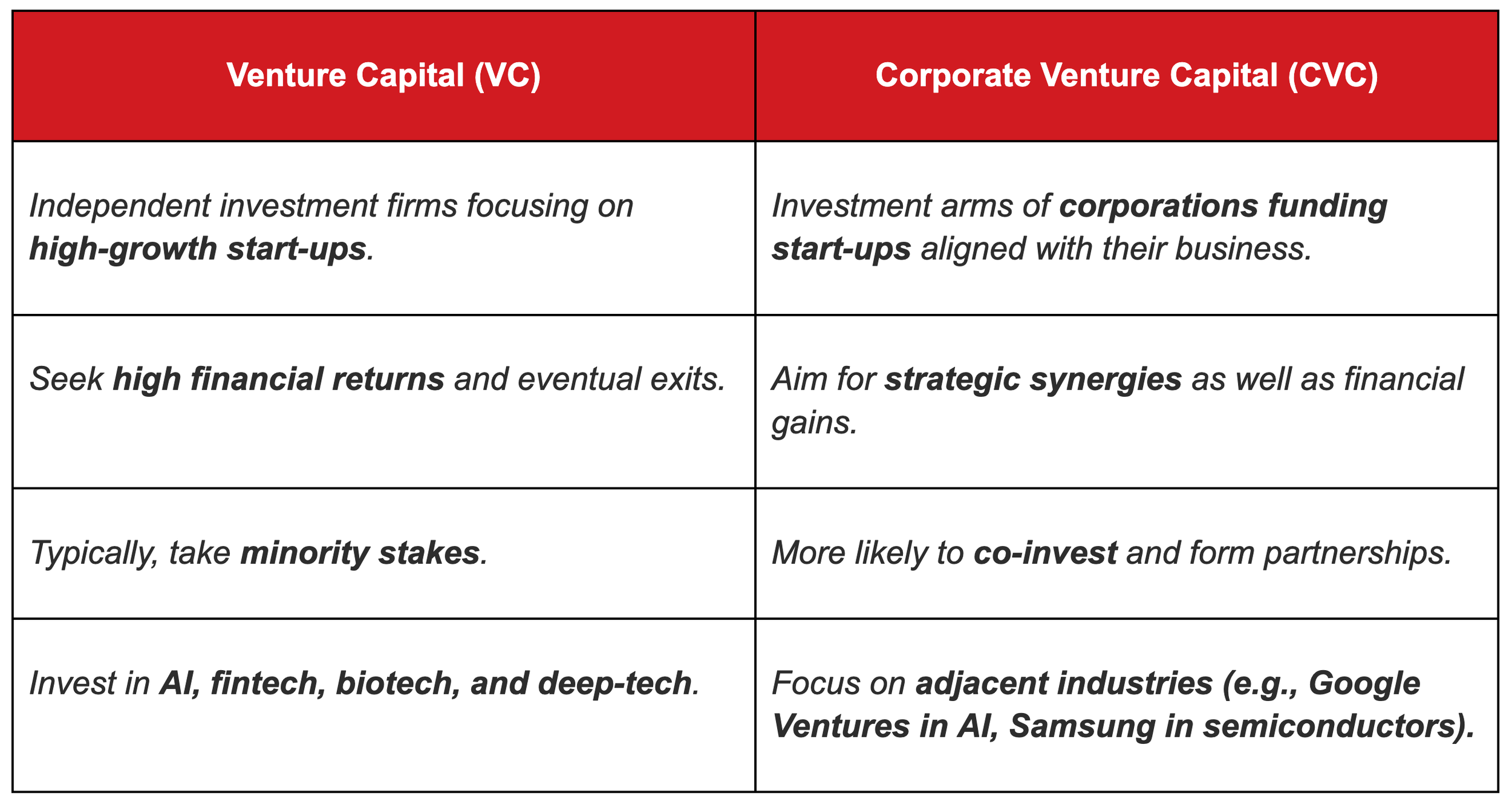
Twofourseven Strategy: Differences between VCs and CVCs.
In 2024, Google Ventures (27 deals), Mitsubishi UFJ Capital (21 deals), and Samsung NEXT (9 deals) emerged as leading CVC investors.
How Can Start-ups Secure Investment in 2025?
With a tougher investment climate, start-ups must adapt to secure funding. Positioning, Perception and Profitability will influence how successful start-up challengers succeed. Here are some strategic views on what founders need to focus on:
Incorporate AI and Automation: Investors prioritise start-ups leveraging AI to improve efficiency, productivity and scalability.
Show a Path to Profitability: The growth-at-all-costs model is over. Sustainable business models with clear revenue strategies are more attractive to investors.
Seek Strategic Partnerships: Aligning with corporate venture capital (CVC) investors can provide credibility and long-term support.
Strengthen Regulatory Compliance: Fintech, AI, and healthcare startups must proactively address regulatory concerns to reduce investment risk.
In these areas, investing in strategic communications and advisory can help companies navigate the challenging economic climate in which innovation is taking place.
The difficult choice for the business and public sectors is that to secure growth, they need to invest and pump prime opportunities.
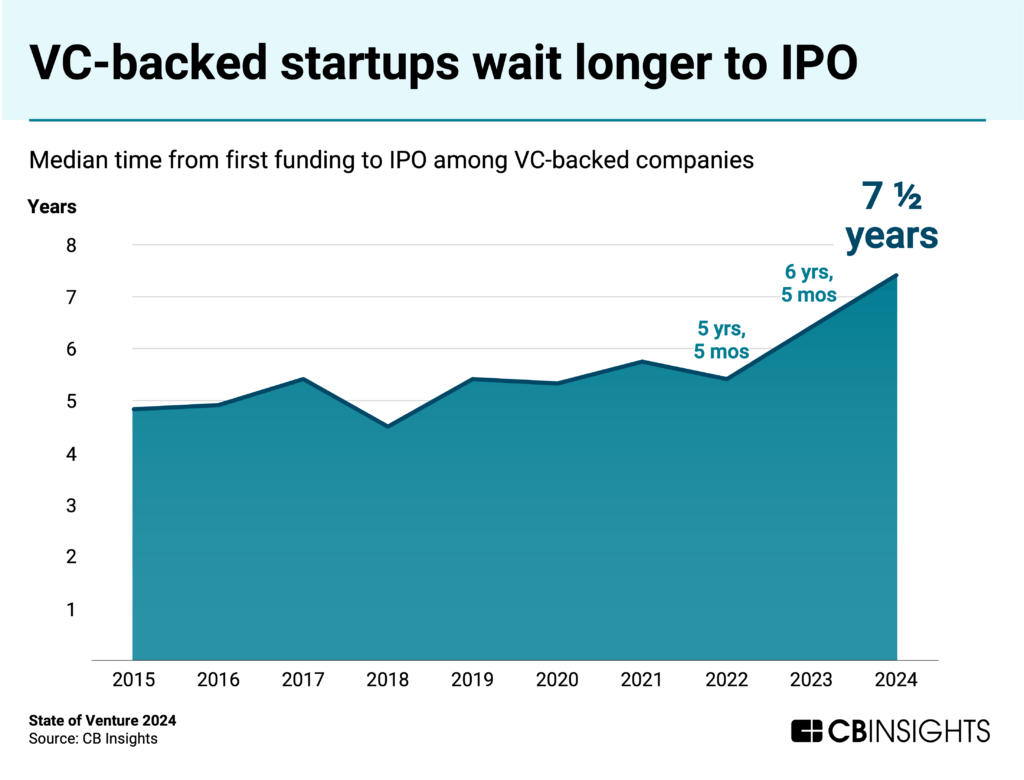
CB Insight: State of Venture 2024
Geopolitical Risks and Government Policies Affecting Venture Investment
Geopolitical Risks Impacting VC Investment
US-China trade tensions are slowing cross-border investments in technology.
Increased AI regulations in Europe and the US are affecting investment decisions.
Rising protectionism in national markets is leading to more scrutiny over foreign investments in sensitive sectors.
Government Policies That Help or Hinder Venture Growth
Countries Supporting VC Growth:
The UK and Singapore offer tax incentives and innovation-friendly regulations, attracting foreign VC investment. Watch out for more policy changes to help attract investors, businesses and opportunities. Understand how there is a need for public-private collaboration, and equally collaboration and support to academic institutions.
Japan and South Korea provide government-backed funding programs to stimulate local venture ecosystems.
Countries Hindering VC Growth:
China’s capital controls and tech sector crackdowns are deterring foreign investors. Given how China is perceived, there is a needs to directly and inderectly reposition itself.
Germany and Canada’s bureaucratic hurdles are slowing down VC deal-making.
Strategic Recommendations for Governments to Attract More Venture Capital
Governments play a pivotal role in shaping the venture capital ecosystem. To attract more investment and foster innovation, policymakers should:
Create Clear AI and Fintech Regulations: Start-ups and investors need predictable, transparent rules to operate confidently. There is a huge need to simplify and redesign the regulatory landscape.
Offer Tax Incentives for Innovation: While expanding R&D tax credits and government-backed funding schemes can drive more venture activity, conversations with businesses, innovators and investors will help governments to re-design an environment where everyone can win.
Encourage Public-Private Collaboration: Corporate venture capital arms are increasingly influential. Governments should facilitate partnerships between start-ups and corporate investors.
The Future of Venture Capital in 2025 and Beyond
Despite global economic headwinds, venture capital remains a critical driver of innovation and economic growth.
Start-ups that leverage AI, demonstrate financial sustainability and build strategic partnerships will be best positioned for success. Meanwhile, governments that create favourable regulatory environments and incentivise investment will continue to attract venture capital and corporate venture capital activity.
The next wave of innovation is already taking shape. The question for investors, start-ups, and policymakers alike is: How will you position yourself for success in the evolving venture landscape?
Get in touch if your business or investment portfolio needs counsel, strategic communications support and advisory.
Strategic communication and stakeholder engagement are central to my expertise, and I’m here to share knowledge or explore potential collaborations.
Please comment, share or subscribe to my LinkedIn Reputation Matters newsletter. Or connect with me on LinkedIn.

How Strategic Communications Can Unlock Value for CVCs
Strategic communications is a game-changer for CEOs, business leaders, and CVC investors, driving higher valuations, stronger acquisitions, and better ROI. Companies with proactive market positioning secure higher valuations and greater acquisition success. Learn how CVCs can unlock long-term growth and competitive advantage through strategic communications and stakeholder engagement.

A few days ago, PitchBook released a Q1 2025 Analyst Note, entitled: “A Lack of Pathway From US CVC Investments to an Eventual M&A,’ in which it highlighted how ‘Corporate venture capital has been an undisputed force in the US venture ecosystem’ and how in the last ten years, it has ‘has accounted for more than 46% of total VC deal value and 21% of deal count.’ Yet, the analyst note identifies that ‘despite having deployed massive capital, CVCs haven’t converted many of their portfolio companies into acquisitions.’ This is an interesting observation and one that requires some context.
Yes, corporate venture capital (CVC) plays a crucial role in funding innovation, enabling corporate leadership, and driving long-term business growth.
When you consider the innovation that we and businesses use today, venture capital companies, especially American VCs, are often recognised for the risk they took and the financial support they delivered. CVCs are less so, but they are critical and a great potential partner for start-ups and innovators.
When Did Corporate Venturing Start?
The concept of corporate ventures started in the 1960s, '70s, and '80s when companies like General Electric (GE), Xero, IBM, and DuPont launched their own ventures in the 1970s and 1980s, exploring new technologies aligned with their industries. It was during the 2010s, though, that CVCs saw a resurgence, driven by the pace of technological innovation. However, the success of startups like Silicon Valley and the need for large companies to stay competitive in an era of digital transformation led to a rise in CVCs.
Today, CVCs have become a significant force in supporting innovation, with over $100 billion deployed annually across diverse industries, from technology and life sciences to energy and consumer goods. Unlike traditional Venture Capital (VC) firms, which primarily seek financial returns, CVCs invest with both strategic and financial objectives in mind. They help companies tap into disruptive innovations, strengthen their supply chains, and foster ecosystem growth, ensuring that both the startups they back and their parent companies benefit.
Why Strategic Communications is a Game-Changer for CVC Investors
Despite accounting for 46% of total US VC deal value over the past decade, CVCs often struggle to convert investments into acquisitions.
According to PitchBook data, less than 4% of portfolio companies are eventually acquired by their corporate sponsors. This low conversion rate presents a challenge in realising the full potential of investments. This should not be seen as a negative, especially given what companies that receive investment get from CVCs in order to grow and scale.
On average, CVCs adopt medium—to long-term investment horizons, withholding periods averaging 5 to 7 years or longer, depending on strategic goals and market conditions.
One of the most overlooked areas in CVC strategy is strategic communications and stakeholder engagement.
Firms that invest in structured communications, investor relations, and strategic market positioning achieve measurably stronger financial performance, with McKinsey & Company (2020) linking such practices to 20–30% higher shareholder returns over time.
Startups prioritising clear market positioning and investor engagement secure significant valuation premiums; CB Insights (2023) highlights that strategically positioned startups in competitive sectors command valuations 25–35% above industry averages. Furthermore, corporate venture capital (CVC) programs integrating communications and regulatory alignment into their strategies demonstrate outsized success: Boston Consulting Group (2022) found these CVCs achieve double the acquisition success rates and 15–20% higher ROI, while Global Corporate Venturing (2021) attributes a 30–40% reduction in regulatory friction to proactive stakeholder engagement. This data underscores the critical role of strategic narrative and regulatory foresight in driving financial and operational outcomes.
Investing in communications de-risks and adds value to the investment and corporate investing.
The Challenge: CVCs Are Leaving Value on the Table
Many CVC-backed startups face challenges in maximising their valuation and acquisition potential. One primary reason is high valuation gaps. PitchBook data reveals that CVC-backed startups have 2.5x higher pre-money valuations than traditional VC-backed startups. This creates acquisition barriers, as corporations find it difficult to justify the expense of integrating these high-valued startups.
Additionally, acquisition rates remain low. Many CVC-backed companies opt for IPOs or secondary exits instead of integrating into their parent organisations. This is partly due to a lack of market positioning and weak corporate visibility, which reduces their attractiveness as acquisition targets. Limited stakeholder engagement also plays a role, as weak corporate visibility impacts investor confidence, media interest, and policy engagement.
Given these challenges, strategic communications becomes an essential tool for CVCs looking to optimise returns, secure acquisitions, and strengthen investor engagement.
How Strategic Communications Unlocks Investment Value
One of the most effective ways to improve CVC outcomes is to be proactive in how a CVC positions itself, privately and publicly, through very tactical media relations, investor storytelling, and government engagement activity.
Companies that invest in communications from the early stages strengthen their market positioning, making them more attractive for both acquisitions and follow-on funding.
For example, Salesforce Ventures, the CVC arm of Salesforce, has demonstrated how communications can drive value. By consistently promoting its investments, highlighting its startup partnerships, and positioning itself as a key player in enterprise technology, Salesforce Ventures has successfully positioned its portfolio companies for exits. The CVC unit has facilitated multiple acquisitions, including its purchase of Mulesoft ($6.5B), Tableau ($15.7B), and Slack ($27.7B), each of which benefited from strong market perception and investor confidence before the acquisition.
Similarly, GV (formerly Google Ventures) has built an industry reputation by maintaining thought leadership and actively promoting its portfolio companies. GV’s investments in Verily (life sciences) and Impossible Foods (alternative protein) have been amplified by strategic storytelling, increasing valuations and driving large-scale partnerships.
The Role of CVCs in Driving Innovation and Market Success
CVCs are not just financial backers but strategic enablers of market-changing innovations. Unlike traditional VC firms, CVCs bring industry expertise, corporate networks, and operational insights that significantly impact startup growth trajectories. However, these advantages must be effectively communicated to key stakeholders—including corporate leadership, investors, and government bodies.
Investing in communications, reputation management, and stakeholder engagement ensures that portfolio companies receive the necessary visibility to attract acquisition interest. A structured stakeholder engagement strategy helps companies navigate regulatory landscapes, position themselves within industry conversations, and increase credibility in financial markets.
Key Recommendations for CVC Investors
To maximise investment returns, CVC firms should integrate strategic communications into their core investment approach.
1. Establish a Strong CVC Brand and Thought Leadership Strategy
Developing a robust and strategic PR and media engagement plan can significantly improve market perception.
Consistently publishing investment insights, funding reports, and thought leadership content ensures that CVC-backed startups gain visibility among investors and potential acquirers.
2. Support Portfolio Companies with Strategic Communications
CVC firms should actively provide startups with branding, messaging, and reputation management resources. This enhances their ability to attract follow-on investment and strengthens acquisition interest from corporate stakeholders.
3. Align CVC Investments with Corporate Storytelling
Many parent companies struggle to see the long-term strategic alignment between their CVC investments and corporate innovation strategies. Positioning investments as part of a broader corporate narrative improves acquisition likelihood and market integration.
4. Strengthen Government & Industry Stakeholder Relationships
Engaging with policymakers, regulators, and industry bodies ensures that CVCs maintain a strong presence in the innovation ecosystem. Proactive engagement can also lead to favourable regulatory conditions, helping portfolio companies scale more effectively.
CVCs Must Invest Beyond Capital
The investment landscape is shifting, and financial capital alone is not enough. CVC investors must recognise that strategic communications, reputation management, and stakeholder engagement are critical levers for maximising return on investment and bringing innovation to market their supply-chain.
CVC firms that proactively invest in communications will see higher acquisition rates, better valuations, and stronger industry influence. Structured communications strategies lead to measurable financial outcomes.
📩 Are you a CVC investor looking to unlock greater value from your investments? Let’s discuss how strategic communications can better position you and transform your investment strategy. Get in touch today!
Please comment, share or subscribe to my LinkedIn Reputation Matters newsletter. Or connect with me on LinkedIn.