AI and deep tech
The technology is rarely the problem. Trust is.
AI, quantum, life sciences and dual-use companies ask investors, governments and customers to back what they cannot fully see. The winners are not always those with the best science or technology. They are the ones whose governance, purpose and limits are understood.
I help founders, corporate venture teams and investors build that understanding, before someone else writes the story for them.
See how I work or start a conversation.
Start here
Latest insights
Four rival AI chief executives have said, within a day of each other, that the industry needs to slow down its race to AGI. Governments listened and entered into a debate. Yet, the people who actually hold the leverage, the investors funding the next round, have barely entered the conversation. Should AI investor governance, not government regulation, be the lever that can actually curb AI risk if AI regulation is slow to establish itself?
AI spending keeps rising, but adoption hasn't followed. See the data behind the efficiency narrative, and why it's building a trust crisis for boards
Geopolitics, AI and governance are rewriting the rules of trust. Here's what new data from the 2026 Oxford University’s GlobeScan Global Corporate survey says, and why it matters to you.
Two landmark global studies published this month reveal something the AI industry is not yet ready to hear. Public trust in AI is falling in the markets that matter most, and the information environment through which people form their opinions about it is in crisis. This is not a communications problem. It is a strategic one. Julio Romo draws on data from the Ipsos AI Monitor 2026 and the Reuters Institute Digital News Report 2026 to examine what the signals mean for AI companies, governments, and investors, and why tactical communications is making the trust deficit worse, not better.
The US just switched off Anthropic's most powerful AI models for the world. Here is what that means for every nation betting on AI for growth.
AI adoption is accelerating. So is the reputational and governance risk for organisations moving faster than the evidence supports
JPM Healthcare 2026 is no longer just about deals. It is a signal-setting moment where life sciences, AI, geopolitics and capital converge. What leaders need to understand.
AI is transforming consulting, but leaders still need human judgment and expertise. This is why strategists skilled in perception, reputation, and trust are essential to harness AI that builds confidence that drives growth.
I explore how deepfakes and generative AI pose rising threats to financial institutions, with verified case studies and strategic recommendations. It follows the deepfake of a Goldman Sachs Chief U.S. Equity Strategist, David Kostin. A must-read for business and investment leaders focused on trust, risk, reputation, and AI governance.
The AI Playbook for the UK Government sets a new benchmark for AI governance, ethical deployment, and risk management in the public sector. Developed by the Government Digital Service (GDS), it provides essential guidance for government leaders, business executives, and technology providers on integrating AI responsibly. Covering AI transparency, security, and procurement best practices, this Playbook is a must-read for decision-makers in UK and global markets looking to engage with the government and harness AI for efficiency, innovation, and trust-building. Learn how AI is transforming public services while maintaining ethical oversight, accountability, and transparency.
The rise of open-source LLMs like Deepseek’s R1 is disrupting the AI landscape, challenging proprietary models from OpenAI, Google, and Microsoft. As businesses and investors weigh the benefits of open-source AI—lower costs, greater customisation, and reduced vendor lock-in—governments are grappling with regulatory concerns, data sovereignty, and national security risks. In this blog I look at the strategic implications of this shift, outlining the risks, opportunities, and how companies, investors, and policymakers can navigate the rapidly evolving AI market.
The Stargate Project, a $500 billion initiative led by the U.S. government, SoftBank, and OpenAI, is set to redefine the global AI landscape. With cutting-edge infrastructure and support from tech giants like Microsoft, Arm, NVIDIA and Oracle, with investment from Softbank, Stargate aims to turbo-charge innovation across industries, from healthcare to energy and manufacturing. This transformative initiative offers unparalleled opportunities for businesses, investors, and governments worldwide. Discover how to navigate the risks, unlock strategic benefits, and position your company, start-up or investment portfolio at the forefront of this AI-driven revolution.
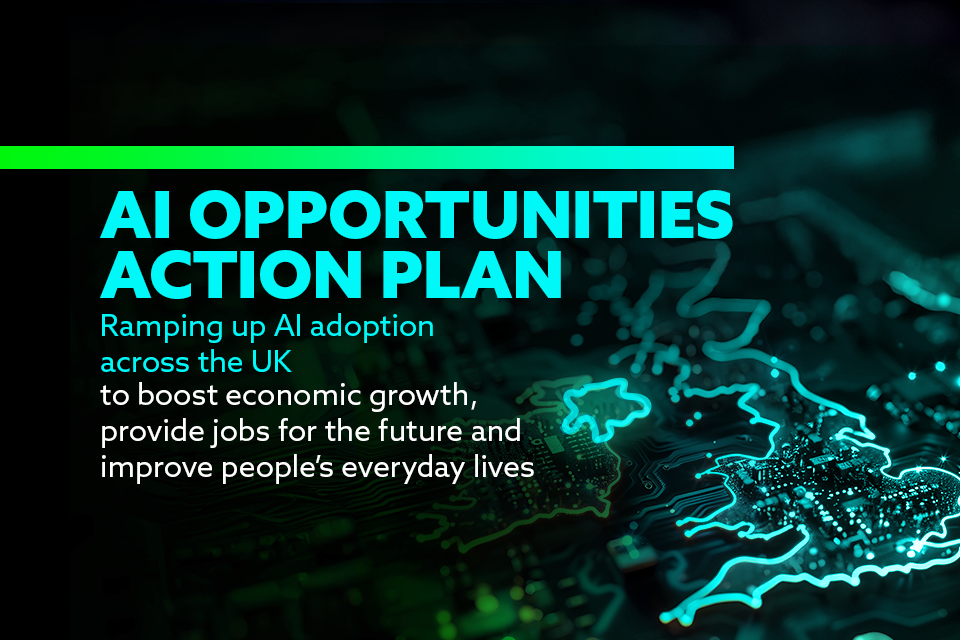
The UK’s AI Opportunities Action Plan targets £400 billion in economic value by 2030. Achieving this vision demands more than investments—it requires a cultural shift from risk aversion to innovation.
This blog explores how policy, fiscal incentives, and strategic communications can drive this transformation. Learn how businesses, investors, and leaders can collaborate to build trust in AI, embrace calculated risks, and shape a future of innovation and prosperity.
As AI transforms industries, people skills and strategic communications are essential for navigating disruption. The Future of Jobs Report 2025 highlights that leadership, adaptability, and stakeholder engagement will define success for companies leveraging AI to drive growth and trust.
'AI & Data in Life Sciences: An Ethical Conundrum?’ An event that focused on the rapidly evolving world of healthcare and life sciences, the groundbreaking advances of artificial intelligence (AI), how this technology can be leveraged to improve diagnostics and service delivery to patients and the importance of healthcare and life sciences companies to build their own trust and reputation.
The rise of Small Language Models (SLMs) is a generative AI solution that could be better at delivering a truly personal experience. Apple Intelligence has opted for a hybrid approach that puts SLMs at the centre of its devices.
The EU has moved first with with EU AI Act. Where next for innovation and growth, and what are the impacts for companies, countries and other trading blocs?
The Board of OpenAI created a crisis out of an internal issue. Their lack of focus or understanding of corporate governance led to not just the sacking of their CEO Sam Altman but their own departure after he returned to lead the company that he co-founded. All because of very poor communication. A lesson to learn for Boards and investors in start-ups everywhere
As AI transforms work, human skills, trust, empathy, and reputation, are becoming the true growth drivers. Leaders in business, government, and investment must use AI for productivity, not just efficiency, to secure long-term resilience and competitive advantage.