Is AI's Efficiency Story Hiding an Adoption Gap?
Last week I watched Bloomberg Opinion columnist and Yale School of Management professor Gautam Mukunda set out three mistakes he keeps seeing business executives making with AI. They are: forcing adoption onto unreliable tools, scapegoating AI for layoffs that were coming anyway, and treating what is fundamentally a managerial challenge as a technical one. He is right on all three. Yet years into the AI investment cycle, we are still talking about how AI is perceived, based on a narrative that has been established for us. And this narrative and perception of AI is still shaping how it gets deployed.
I've been writing about this exact failure pattern for months. The efficiency narrative that keeps AI spending flowing, faster output, lower headcount, leaner processes, is not just a management mistake. It is the story that justifies the capital, and it consistently skips over the one variable that actually determines whether any of it works: human adoption.
The AI adoption gap is the difference between how many employees have access to AI tools and how many actually use them.
If we let the AI narrative stay about efficiency rather than genuine productivity, we are heading for a trust and perception crisis considerably larger than the one Mukunda describes.
What Does Gautam Mukunda Get Right About AI Adoption?
In his Bloomberg Opinion piece, Mukunda sets out three approaches he sees causing more problems than they solve. The first is forcing employees to use AI tools that are, by his account, still unreliable: they break, they hallucinate, and they occasionally act against explicit instructions. The second is executives quietly blaming AI for layoffs that have little to do with the technology itself, a pattern he notes even OpenAI's Sam Altman has acknowledged happening elsewhere in the industry. The third, and the one I think matters most, is the tendency to treat AI as a technical rollout rather than a managerial one, because people just do not get the same attention and investment. AI is the flashing light that secures attention.
Mukunda makes the argument that revolutionary technologies, like what AI can be, do not arrive and simply do existing jobs a little better. They succeed by meeting what he calls 'dark demand', the work that has always needed doing but that nothing on the market has been good or affordable enough to fulfil. His reference point is Bessemer steel in the 1800s: once cheap enough to leave the workshop and enter the world, it did not improve on what came before, it became the material the modern world was built from. AI, in his view, will only deliver on that scale if organisations give employees the room to experiment, fail, which is critical and must be allowed, and reinvent how they work around the new capability.
I agree with the points he makes. Where I want to take this further is in what happens next, because we keep assuming it's the technology alone that will deliver a transformative wave of innovation. What actually transforms work, and societies, is people. And the current narrative has very little incentive to say so, because we are not investing enough in people so they can unlock the potential of not just AI, but us, humans.
The Capital Narrative Behind the Efficiency Story
The issue I have is about the narrative about 'efficiency', which has been allowed to establish itself as the golden thread that allows executives to invest in AI. It is the story that justifies the money.
Global IT spending is projected to reach $6.31 trillion this year in 2026, up 13.5 percent on 2025, driven largely by AI infrastructure, software and cloud services, according to Gartner. Microsoft, Meta and Amazon have each guided to tens of billions of dollars in AI-related capital expenditure this year alone. Spending at that scale needs a story that satisfies markets, and 'AI will make your organisation dramatically more efficient' is a cleaner pitch to investors and boards than 'AI requires years of organisational redesign before it pays for itself.'
The trouble is the economics increasingly do not support the pitch. Nvidia's own vice president of applied deep learning, Bryan Catanzaro, told Axios earlier this year that for his team, the cost of compute is now running ahead of the cost of the employees it was meant to offset. At the same time, a 2024 MIT study focused specifically on computer vision automation, examining whether AI was genuinely cheaper than a human across a defined set of tasks, found it was actually the more cost-effective option in only 23 percent of cases. Uber's chief technology officer reportedly exhausted the company's entire 2026 AI coding budget within four months. None of this means AI has no value. It means the case for adopting it at speed is being made on efficiency grounds the underlying cost data does not yet fully support, and that is precisely the kind of gap between narrative and reality that erodes trust once it becomes visible.
The Adoption Gap the Narrative Leaves Out
Here is what the efficiency story misses: most organisations have not solved adoption, and the gap is now extensively documented. IBM's Institute for Business Value found that 85 percent of employees have access to AI tools at work, but only 25 percent use them regularly, even though 86 percent of CEOs believe their people are ready for it. US Census Bureau figures for May 2026 tell a similar story at the economy-wide level: AI use sits at somewhere between 17 and 20 percent of businesses overall, concentrated heavily in large firms and information-intensive sectors.
Where AI is used, the quality of that use is itself in question. Workday's global research found that only 14 percent of employees consistently achieve net-positive outcomes from AI use, with highly engaged employees losing an average of about 1.5 weeks a year to rework, and nearly nine in ten organisations have updated fewer than half their roles to actually work with AI. Stanford and BetterUp researchers have given this failure mode a name, 'workslop', AI-generated output that looks finished but lacks substance: 41 percent of US workers reported receiving it in the preceding month, each incident costing roughly two hours to resolve. This is the point Mukunda highlights, treating AI as a technical rollout rather than a managerial one, showing up as hard, replicated data rather than as a single observation. Access was never the constraint. Adoption is, and adoption is slow, human, organisational work that a capital-raising narrative has no incentive to wait for.
Why Efficiency Is the Wrong Frame
The dominant AI narrative today, in boardrooms and in governments, is still efficiency. That framing is not wrong, but it is dangerously incomplete, because it measures the thing that is easiest to count rather than the thing that actually determines whether adoption survives contact with reality.
I made a version of this argument after reviewing the Ipsos AI Monitor 2026 and the Reuters Institute Digital News Report 2026 together. The data showed that public trust in AI is not primarily a communications problem. It is a strategic one, and treating it as a messaging exercise actively makes the underlying deficit worse rather than better. PwC's 2026 AI Performance Study, surveying 1,217 senior executives across 25 sectors, adds a sharper edge to this: nearly three-quarters of AI's economic value is being captured by just one-fifth of organisations, and what distinguishes the leaders is not more tooling, it is pointing AI at genuine business redesign rather than efficiency alone.
Here is the comparison worth sitting with before the next budget cycle locks in another year of the same approach.
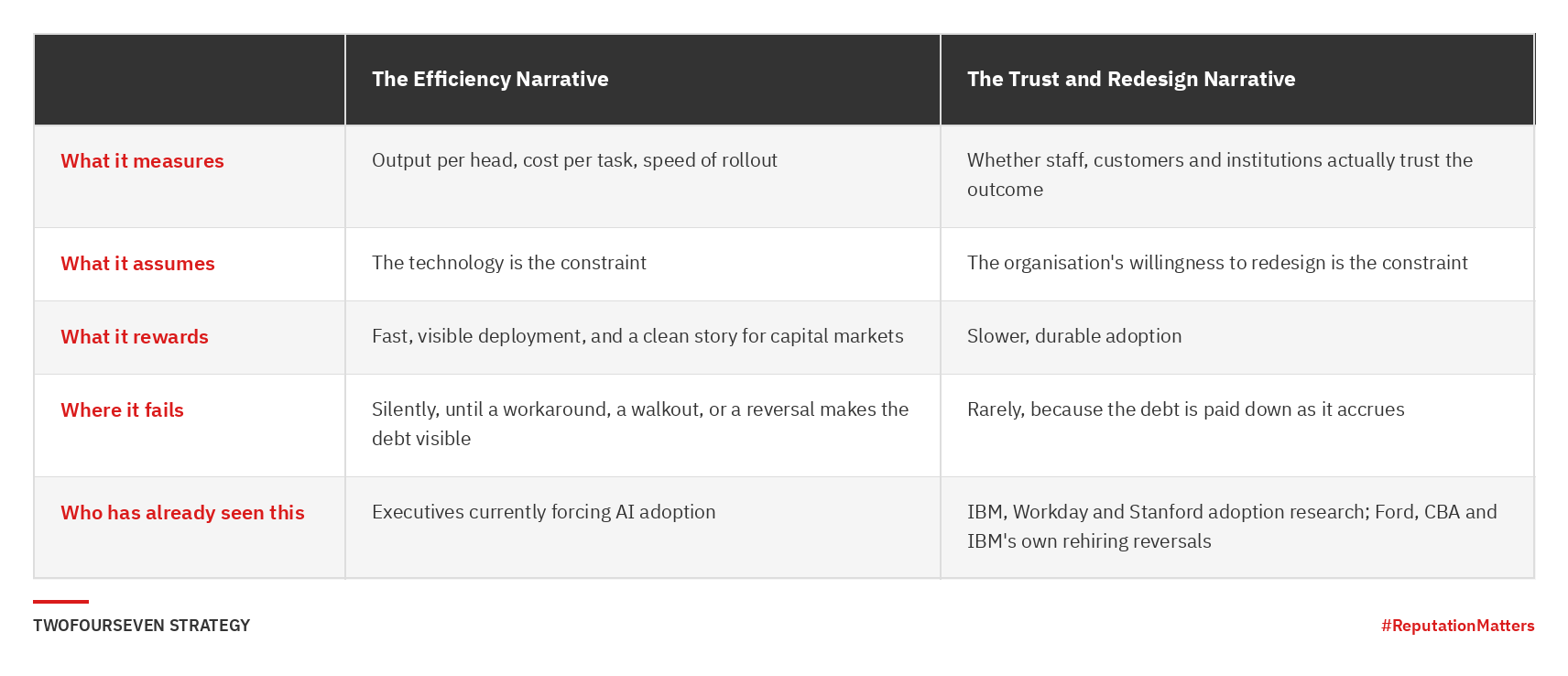
The efficiency narrative and the trust-and-redesign narrative measure AI adoption differently, and only one of them survives contact with reality
None of this means efficiency is the wrong outcome to want. It means efficiency cannot be the only thing you are measuring, or the only story you are telling the market, because the gap between the story and the data is exactly where trust gets spent.
What Happens If the Narrative Wins Anyway
This is no longer hypothetical. Ford has rehired and promoted more than 350 experienced engineers after automated quality-control systems failed to capture the expertise veteran staff provided. Commonwealth Bank of Australia reversed a redundancy of more than 40 customer service roles after its AI voice bot could not cope with call volumes. IBM's AI-run HR system handled roughly 94 percent of requests but failed on the 6 percent requiring ethical judgement, prompting IBM to triple its US entry-level hiring in 2026. Separately, research firm Orgvue found 39 percent of business leaders had laid off staff citing AI, and 55 percent later concluded the decision had been a mistake.
Each of these organisations followed the efficiency narrative first and discovered the human and organisational cost of skipping the redesign work second. That correction is already underway, quietly, in rehiring announcements that get a fraction of the coverage the original layoffs did. The risks compound from here in three specific ways: the redesign debt becomes structural rather than incidental, since organisations that never rebuilt workflows around AI find the gap between stated capability and delivered reality widening every quarter; the trust deficit stops being a perception problem and becomes an operating constraint, converting public ambivalence into active resistance faster than leadership teams currently expect; and the institutions that do the redesign work properly pull decisively ahead, not because of better models, but because of earned permission to operate at speed.
What Boards, Founders and Senior Government Officials Should Ask Now
For boards and senior leaders
Where in our AI rollout are we measuring speed and cost, and where are we measuring whether staff and customers actually trust the outcome?
If we cut headcount on the assumption that AI would cover the gap, have we checked whether that assumption has held, given how many of our peers are already quietly reversing the same decision?
Who owns the trust and redesign debt in this organisation at board level, rather than inside a delivery team's backlog?
For founders and scale-ups
Are we building tools that assume the organisational redesign work has already happened, or are we helping customers do that work as part of adoption?
What does our product do the first time it fails visibly in front of a user who was never trained for that moment?
Are we scaling reliability at the same pace we are scaling capability, and the same pace we are scaling the story we tell investors?
For senior government officials
What did the last major digital transformation programme teach this department about adoption that AI planning has already forgotten?
Is user research genuinely built into AI service design, or has it been assumed away because the technology looks more capable than what came before?
Where is accountability for AI trust and adoption sitting in the department, and does it have the same seniority as accountability for delivery timelines?
Reputation Matters
Mukunda is describing symptoms correctly. The issue underneath is the same one the adoption data confirms and the Ford, CBA and IBM reversals prove: it was never a technology problem. It is whether an organisation is willing to slow down enough to redesign around a new capability, resist the market pressure to promise efficiency and fast rollout before that work is done, and measure the trust it is spending as honestly as it measures the efficiency it is claiming.
The organisations that get this right will not be the ones with the most capable models. They will be the ones that treated the human and institutional work as seriously as the technical work, and that stopped letting the capital narrative set the timeline for the adoption work underneath it.