Government and policy
Working and engaging with governments takes more than a good case. It takes knowing the processes, the blockers, who decides, what they need and when and who to speak with.
I worked inside UK government from 2016 to 2024. I have also worked with engaged with governments in Europe, the GGC, South East Asia and Japan. Now I help businesses and investors in three steps. Discovery: understand the policy and the people behind it. Engagement: open the right conversations. Outcome: a relationship that delivers for both sides.
See how I work or start a conversation.
Start here
Latest insights
Burnham, Healey and Reynolds are now responsible for growth. William Hague, Chancellor of Oxford University and former Leader of the Conservative Party, says Britain's problem isn't invention, but conversion and commercialisation. He's right. But we also need to talk about culture, and the risk-averse mindset that holds back British innovation instead of rewarding it.
In 2023 I watched Andy Burnham at SXSW in Austin. He was not performing engagement. He was listening. Technology companies noticed. Investors noticed. Manchester benefited. Today's speech reflects exactly that instinct: growth and trust are built from proximity, not imposed from the centre. The question is whether the British state can be rewired quickly enough to make it work.
Bond markets are not the enemy of governments. They are the trustees of other people's futures, and they are asking one question that too many policy teams are failing to answer.
Why UK professional services needs a positioning strategy, demand-side policy, and not just more capital. Trust is the UK's overlooked competitive advantage.
The UK Budget 2025, delivered by Rachel Reeves, highlights a deeper issue affecting governments and investors worldwide: confidence is shaped less by policy than by how leaders communicate. When messaging is fragmented or inconsistent, markets assume the worst. In this blog, I explain why narrative discipline now shapes capital flows, valuations and international trust, and outline five strategic steps leaders must take to rebuild confidence.
Why is the Labour government’s message not landing? After a year, the agile communications of opposition have been replaced by a cautious civil service and an outdated focus on press, ignoring how public opinion is shaped online. Businesses can become a credible partner by forming coalitions and presenting solution-led proposals that align with national missions, helping the government deliver.
Britain has no shortage of talent or ideas, but it lacks a culture that truly values ambition, risk-taking, and entrepreneurial success. While US founders are celebrated, UK entrepreneurs are met with scepticism, short-sighted policy, and a narrative that undermines their contribution. I explore the damaging myths around wealth creation, the perception gap at the heart of UK policymaking, and the steps we must take to reposition entrepreneurship as a national asset, not a problem to manage.
The UK government faces a credibility problem, struggling to move beyond rhetoric to deliver tangible economic growth. This piece argues for a shift from "headline economics" to concrete frameworks that mobilise capital, outlining five recommendations for transforming policy ambitions into real-world impact.
Europe’s deep-tech ambitions depend on more than just research and capital, they hinge on trust, strategic collaboration, and clear communication. The European Innovation Council’s latest Corporate Startup Collaboration report shows how the EU is working to unlock growth through corporate venture capital (CVC). But to truly compete with the U.S. and Asia, Europe must go further: aligning incentives, strengthening positioning, and using strategic communications to build confidence and scale impact.
Britain stands at a strategic crossroads, with policy, capital, and innovation aligning. As the UK enters a “Goldilocks moment,” family offices and venture investors must act decisively to turn this rare opportunity into long-term growth, trust, and national competitiveness.
Brent Hoberman’s question—“How good is the data that governments use to make choices?”—spotlights a deeper issue: it’s not just about the data, but the people and culture behind it. In this article I explore how risk aversion, silos, and bias hinder policy impact—and what leaders can do to fix it.
The recent fire at Heathrow Airport exposed more than a power outage—it revealed critical gaps in the UK’s infrastructure resilience and crisis readiness. For leaders in government and business, the incident is a stark reminder: resilience, reputation, and rapid response must be built into strategic planning now.
The UK Government’s digital reform agenda is ambitious, but without strategic communication and stakeholder engagement, it risks resistance and slow adoption. Embedding communications within Agile teams ensures alignment, trust, and success. Discover why communication is the missing link in digital transformation.
The Trump administration's 'America First' strategy is creating global instability. This approach could backfire and hinder the US. In this blog post, I'll explore how governments and businesses can navigate this new world of trade and policy. I'll analyze the impact of controversial trade policies and offer strategic advice for international governments, US and multinational corporations, and investors.
The AI Playbook for the UK Government sets a new benchmark for AI governance, ethical deployment, and risk management in the public sector. Developed by the Government Digital Service (GDS), it provides essential guidance for government leaders, business executives, and technology providers on integrating AI responsibly. Covering AI transparency, security, and procurement best practices, this Playbook is a must-read for decision-makers in UK and global markets looking to engage with the government and harness AI for efficiency, innovation, and trust-building. Learn how AI is transforming public services while maintaining ethical oversight, accountability, and transparency.
A readout from Lord Livermore’s Number 10 briefing with public affairs professionals, outlining the UK government’s economic growth strategy and the critical role businesses play. The discussion and question and answers highlighted the government’s three-pillar approach—stability, reform, and investment—while addressing key challenges such as regulatory barriers, planning delays, and post-Brexit trade relations. This readout captures the key insights, business implications, and how companies can engage with policymakers to shape the UK’s economic future.
The UK’s AI Opportunities Action Plan targets £400 billion in economic value by 2030. Achieving this vision demands more than investments—it requires a cultural shift from risk aversion to innovation.
This blog explores how policy, fiscal incentives, and strategic communications can drive this transformation. Learn how businesses, investors, and leaders can collaborate to build trust in AI, embrace calculated risks, and shape a future of innovation and prosperity.
Creating an entrepreneurial and innovation mindset in governments needs strategic thinking and critical stakeholder engagement if it is to unlock growth for nations and businesses. Martin Wold and Mariana Mazzucato share insights on what the future could be like if the public and private sectors learnt to better support each other.
Consultation on the UK’s new Industrial Strategy has closed. What is needed is the establishment of a culture of collaboration that unlocks the value in the innovation that ranks us fifth in the global innovation index. Business executives need to reposition themselves if they are to benefit from the high-tech future being designed by the new Labour government.
UK universities technology transfer and spin-outs fuel innovation and economic growth. As a nation, we are fifth the global innovation index, yet, compared to other nations, more needs to be done to turn research that our academics do into transformative science and technology that can deliver growth and jobs. We are competing on the global stage and we need effective positioning and strategic communications.
Today, the UK government published its Industrial Strategy Green Paper, a public consultation that asks businesses to' help shape the industrial strategy.’ Timed to coincide with the International Investment Summit, the Green Paper presents the government’s vision for driving long-term economic growth. Yet, while it is being unveiled at a gathering of international investors, the UK must support the creation of a corporate venture capital ecosystem that can support UK innovation that can deliver growth.
How will the new Labour Government deliver change and an improvement in the quality of life for the public? It needs to redesign the Government, establish an entrepreneurial culture and create an ecosystem where business can invest in innovation.
With trust in government and politicians at an all-time low, effective communications, good presentation and good optics will be central in the 2024 UK general election.
The UK and Europe are lagging behind the US in maximising the potential of tech companies founded in their respective national markets, but why?
Culture, perception and confidence are holding us. How do we resolve this?
The EU has moved first with with EU AI Act. Where next for innovation and growth, and what are the impacts for companies, countries and other trading blocs?
The Government’s plans to regulate content and police the internet might be over-ambitious if it doesn’t empower its regulator.
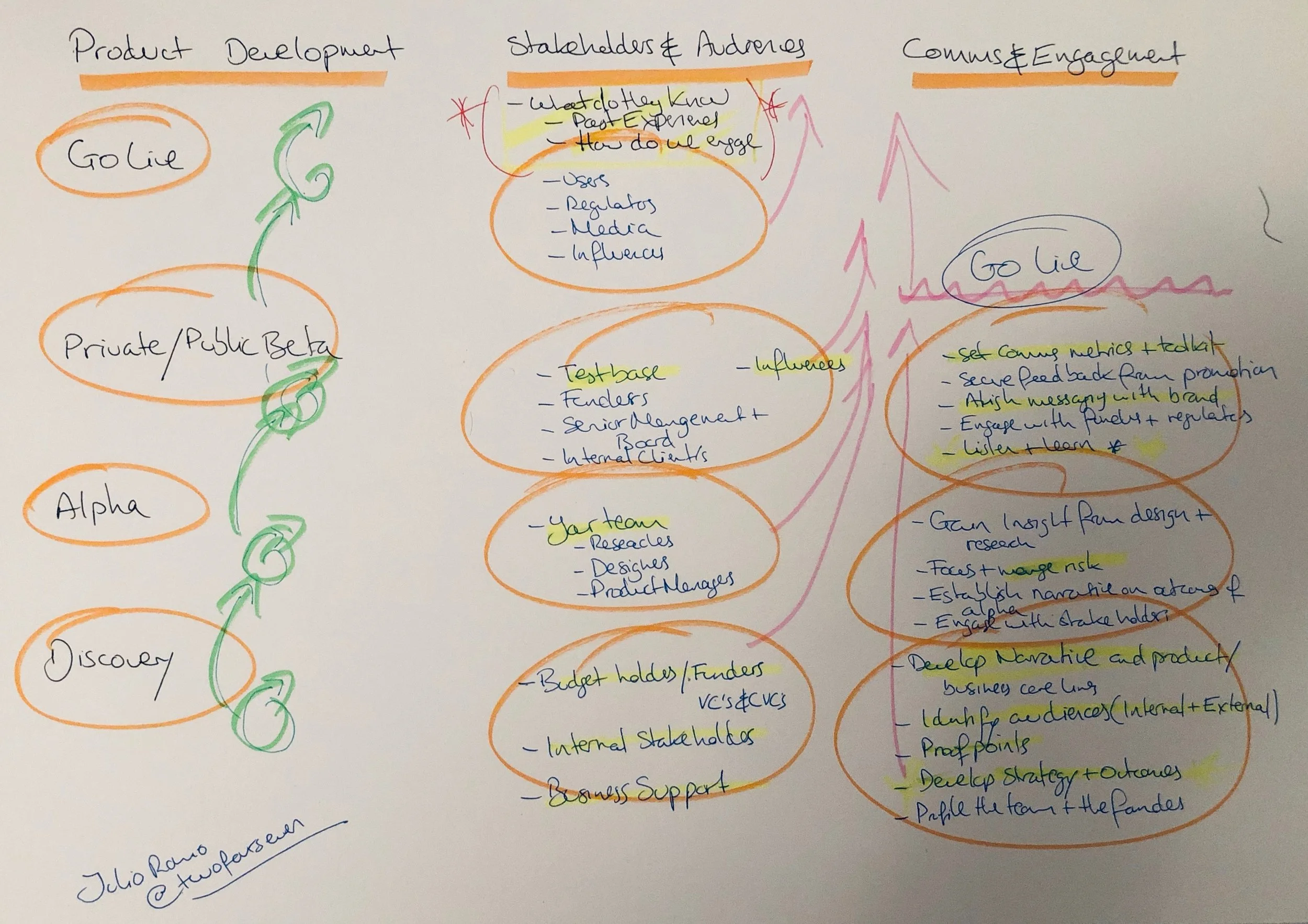
Building digital services is complicated, it takes time and money, and the journey to delivery is full of risk.
Getting the service or technology adopted though is all about setting and managing expectations. For too many products though, the communications happens just before the go-live, when public relations and marketing is commissioned. But is this right? Can communications and engagement better support in the managing of risk during the design and development stages? After all, experience isn’t just set by the interaction with a product, expectations are met, or not, by what users are told before the go-live, by the narrative that is set and promoted.
The UK’s 2025 Budget raised taxes to historic highs but failed to reduce regulatory friction or unlock investment. Here is why these risks pose a long-term growth and why the narrative will impact how UK businesses see the benefit of investing.